 Dino Kids
The year before kindergarten is often the year parents worry most. Other parents talk about readiness assessments and workbooks; someone mentions that their child already reads chapter books. Every worry comes back to one question: how do you prepare your child for kindergarten well enough, without turning the last year of early childhood into a year of drills?

This article walks through the seven worries parents raise most often, says plainly what kindergarten actually expects, and explains which of them Dino Kids can help with, and which it can't.
What "kindergarten readiness" really means
Kindergarten readiness is less a list of academic skills than a mix of things: being healthy and reasonably independent, able to listen and follow simple directions, curious, and comfortable around letters and numbers.
A useful reality check comes from the developmental milestones published by the U.S. Centers for Disease Control and Prevention (CDC), which describe what most children (75% or more) can do by a given age. By five, most children can count to 10, name some letters when you point to them, and write some letters of their name. Not read. Not write sentences. Kindergarten is where children are taught letter sounds and early reading; it is designed to teach those skills, not to test whether a child arrives with them.
So why the worry? Because one classroom can hold a child who reads fluently next to one who doesn't know the letters yet, because school moves faster than preschool, and because no parent wants their child to feel "behind" in the first weeks.
Worry 1: "My 5 year old is not reading yet. Will they keep up?"
Children don't need to read before kindergarten. What helps them keep up are the bricks that come before reading: recognizing a few letters, hearing the first sound of a word ("apple" starts with /a/), loving stories, and not being afraid of books.
What Dino Kids does: in the English subject, the "ABC" chart has a card for each of the 26 letters. Tap one and the app says the letter's name and then an example word ("ay … apple"), with a picture for children who can't read yet. "Write English letters" lets your child trace capital and lowercase A–Z in the right stroke order, and the app checks each stroke. "Numbers" shows 0 to 20 as a numeral, a row of dots to count and the English word, read aloud.
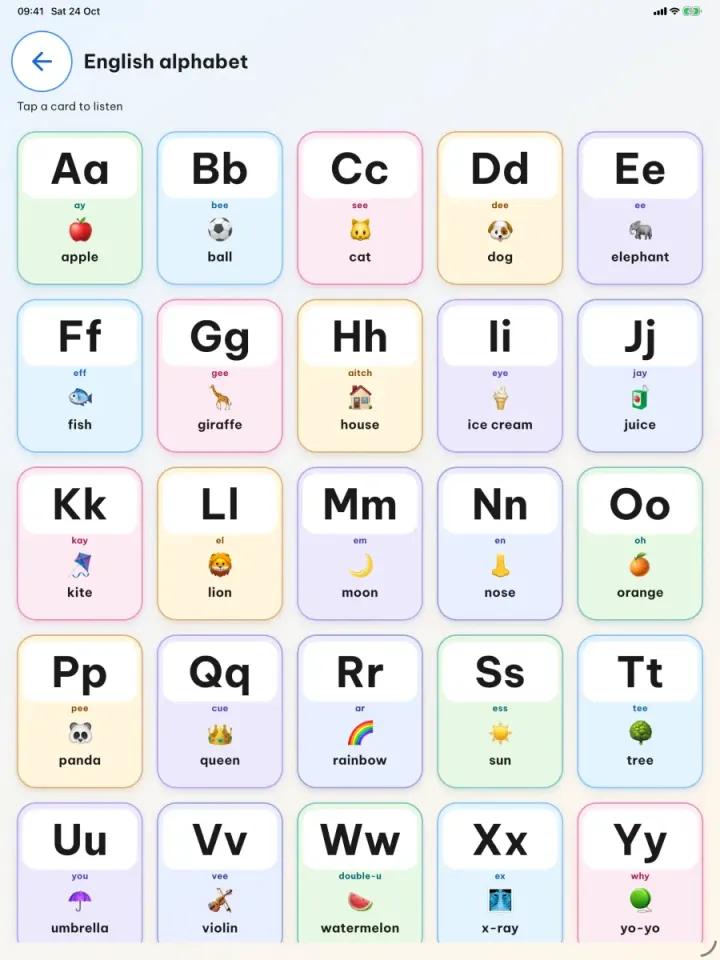
Every instruction in Dino Kids is read aloud, so a child who can't read can still play on their own.
Worry 2: "Should we start kindergarten prep early?"
This is the hardest question, and the answer lies in how. Hours at a table copying letters, red crosses and comparisons with other kids can teach a child to dislike learning before school even starts. A little play with letters and numbers each day, at the child's own pace, is a natural kind of preparation any family can do.
What Dino Kids does: the app is built for the second kind. A child never gets zero stars, and there are no crosses and no red marks. After a first wrong tap the card just blinks; after a second, the wrong choices fade a little; after a third, the app shows the answer and moves on. Lessons open in order, so a child doesn't jump into one that's far too hard, while you can still see the whole path. Finishing a lesson earns a ticket to Playtime.
Dino Kids isn't a head-start class. It's a place to play with letters and numbers, to meet the things your child will learn later, without pressure.
Worry 3: "My 5 year old can't write their name, and holds the pencil wrong"
At this age, the thing to watch isn't neat handwriting but habits: sitting well, holding a pencil correctly, drawing lines from top to bottom and left to right. Bad habits take a long time to undo; neat handwriting is what school is for.
What Dino Kids does: "Write English letters" and "Write numbers" are tracing practice, one letter at a time, in stroke order: good for learning shapes and the order of strokes.
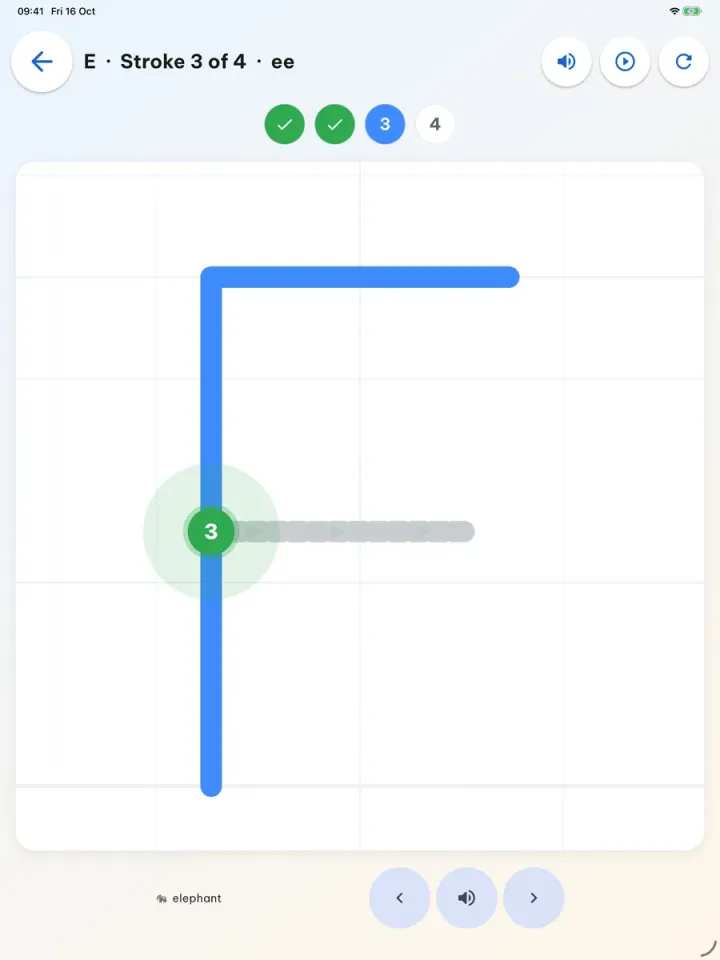
To be honest: a finger on a screen doesn't replace a pencil on paper. The app helps your child remember what letters look like and how they're formed; the hand itself still needs coloring, drawing and cutting on real paper. Dot-to-dot, mazes and coloring in the app are a warm-up for that, not handwriting lessons.
Worry 4: "What if math is too hard?"
Kindergarten math starts with counting, recognizing numerals, comparing more and fewer, and simple adding and taking away with small numbers. A child who can count real objects and understands "add one more" and "take one away" has a good foundation.
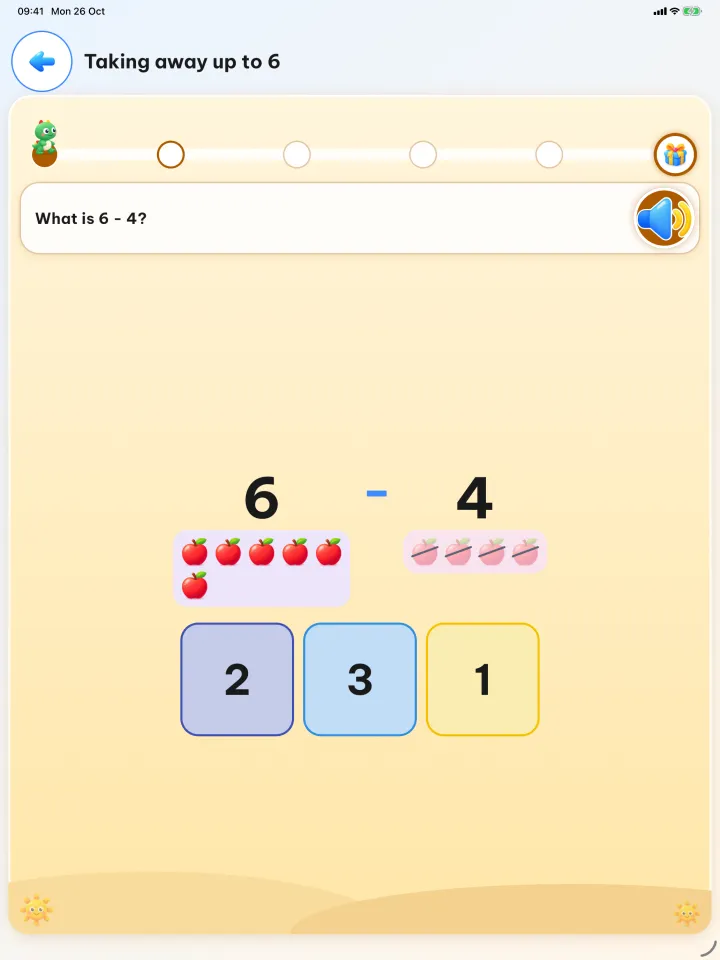
What Dino Kids does: "Math" has five units: shapes (square, circle, triangle, rectangle), numbers 0–10, comparing (more, fewer, the same, and the signs > < =), adding and subtracting within 10, and review. Five-year-olds can't do sums in their heads yet, so every problem has objects to count drawn under the numbers; the amount being taken away is drawn faded and crossed with a soft line, so children don't count everything together.

The third tile in Math is "Thinking math"  : 28 lessons on patterns, sorting, position, size and reasoning, the skills that come before arithmetic. Read more in Thinking math for kids 3 to 6.
Worry 5: "My child can't sit still for long"
A five-year-old typically pays attention for about 5 to 10 minutes during an activity (CDC milestones). The ability to sit longer grows with age, and there's no need to force it early.
What Dino Kids does: each lesson is short enough for one sitting. At the top of the home screen, "Three things today" offers three small tasks, each ticked off when done, so your child knows what to do today without choosing from a dozen tiles. Three things, then stop: "learn a little, then rest" is a good habit to bring to school. For overall screen time, the built-in controls on iPad, iPhone and Android let you set limits for the whole device.

Worry 6: "My child is shy and anxious about starting school"
This is the part an app can't replace. Getting a child emotionally ready for kindergarten takes real people: walking past the school together, talking through a school day, practicing using the bathroom alone, opening a lunchbox, and saying "can you help me?".
Where Dino Kids helps a little: Stories has folk tales with narration. Listening to a whole story, retelling it and answering questions about it are skills kindergarten teachers use every day. A story shared at bedtime is also a good moment to ask what your child is worried about.
Worry 7: "I'm busy and don't know how far my child has got"
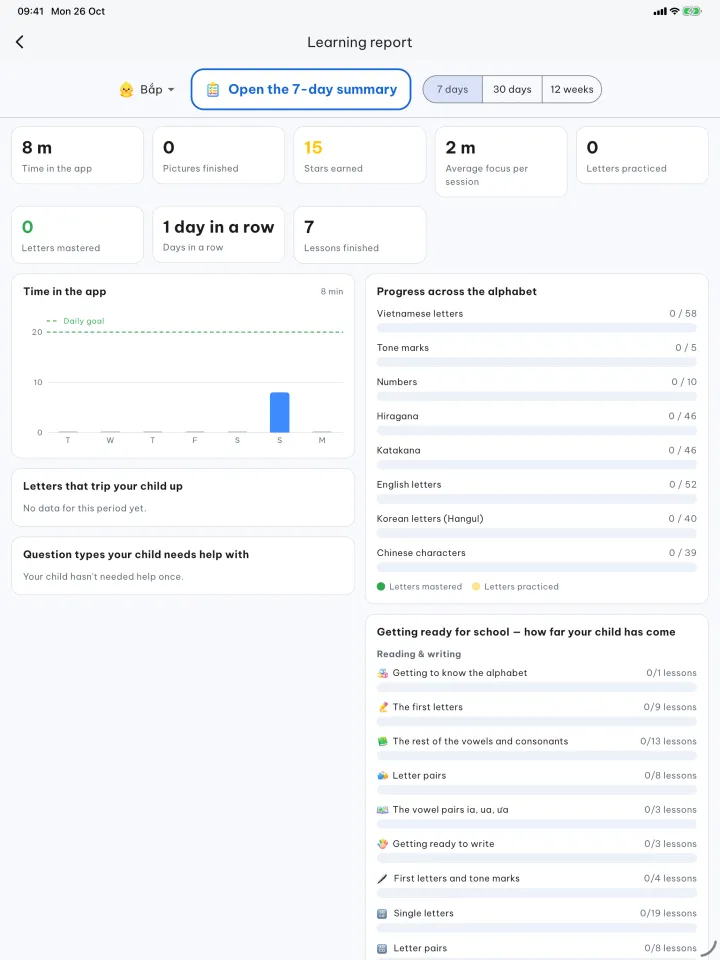
What Dino Kids does: in  Settings, the "Learning report" shows lessons finished in each unit, the kinds of questions your child often gets wrong, the letters they find hard to write, and how long they learned each day. Each child has their own profile, so siblings' progress doesn't mix. With an account, progress syncs between an iPad and a phone. Ten minutes sitting next to your child asking "how did you do that?" is worth far more than an hour of them playing alone.
Kindergarten readiness checklist for parents
There's no entrance exam to pass. The list below is about helping your child feel confident in the first weeks, not a standard to tick off completely:
- Independence: uses the bathroom, eats, puts on a coat and tidies their things alone.
- Listening: follows two- or three-step directions, waits for a turn, raises a hand to speak.
- Language: says their own name and their parents' names, retells a short story with a beginning and an end.
- Letters: recognizes some letters, especially the ones in their name; enjoys being read to.
- Numbers: counts objects to 10, compares more and fewer, knows a few basic shapes.
- Hands: holds a pencil correctly, colors, draws straight and curved lines.
- Feelings: can say when they're sad or scared, and can ask for help.
If your child isn't there on a few items yet, that's normal. Children develop at different paces, and kindergarten has a whole year for them to grow.
Good to know
- Dino Kids is on the App Store and Google Play, for iPad, iPhone and Android. It is free: no ads, no in-app purchases. Dino Kids is a product Digi Dinos makes for the community, not a revenue channel.
- Math and Thinking math come in five languages (Vietnamese, Japanese, English, Korean and Chinese), with every question read aloud.
- The first lesson of Math and of Thinking math is built into the app. Later lessons download automatically whenever the device is online, no account needed; once downloaded, they work offline. An account only adds syncing of artwork and progress between devices.
- The English letter shapes, example words and lessons were made by the Dino Kids team; the pictures are your device's emoji. If a lesson doesn't suit your child, or you'd like another kind of exercise, write to us at dinokids@digidinos.com.