 Dino Kids
Long before they can count to ten, children are already doing maths in their own way. They pair up socks. They notice that a striped shirt goes red, white, red, white. They protest that their brother's slice of cake is bigger, and they know the cat is hiding under the table, not on it. In those moments a child is spotting patterns, sorting, comparing and locating things: the first building blocks of mathematics, which come before numbers do.
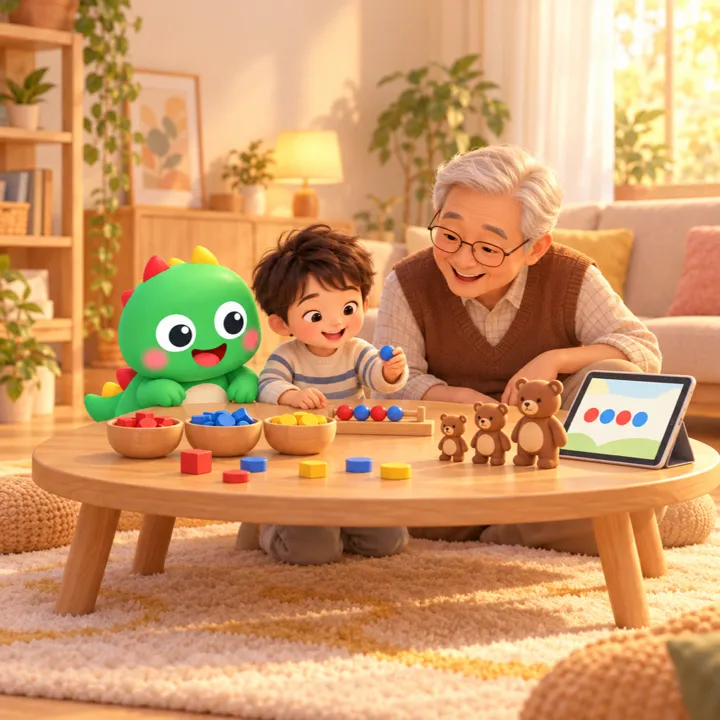
This article covers what thinking math is, why researchers take these skills seriously, how to help a 3–6-year-old learn them without pressure, and what your child can learn in the Thinking math section of Dino Kids.
What is thinking math?
Here, thinking math is not about doing sums fast in your head. It is the kinds of thinking that come before calculation:
- Patterns: seeing that something repeats and guessing what comes next.
- Sorting: grouping things that belong together, and spotting the one that doesn't.
- Position and space: on, under, in, out, next to, left, right.
- Size: big and small, long and short, heavy and light, ordering from smallest to biggest.
- Order and reasoning: what happens first and what comes after; if this goes with that, what goes with the new thing?
None of these needs a child who can read or count well. Your child only has to look closely, compare, and little by little say why they chose what they did.
Why these skills matter
A few solid long-term studies link early maths with later learning:
- An analysis of six datasets that followed children for years (Duncan et al., 2007) found that among the skills measured when children started school (maths, reading and attention), early maths was the clearest predictor of later achievement.
- A study following more than 500 children from age 4 to 11 (Rittle-Johnson et al., 2017) found that knowledge of patterns in preschool, together with counting and comparing quantities, predicted maths achievement in fifth grade. The authors suggested giving patterns more room in preschool and the early school years.
- A review (Young, Levine and Mix, 2018) concluded that spatial skills and maths skills are related throughout childhood, although how they support each other is still being studied.
To be fair to the evidence: these are observed links, not a promise that an app or a course will make a child good at maths. What they suggest is simpler. Everyday games of comparing, sorting and finding patterns are worth doing with your child, and worth starting early.
Learning that suits ages 3–6
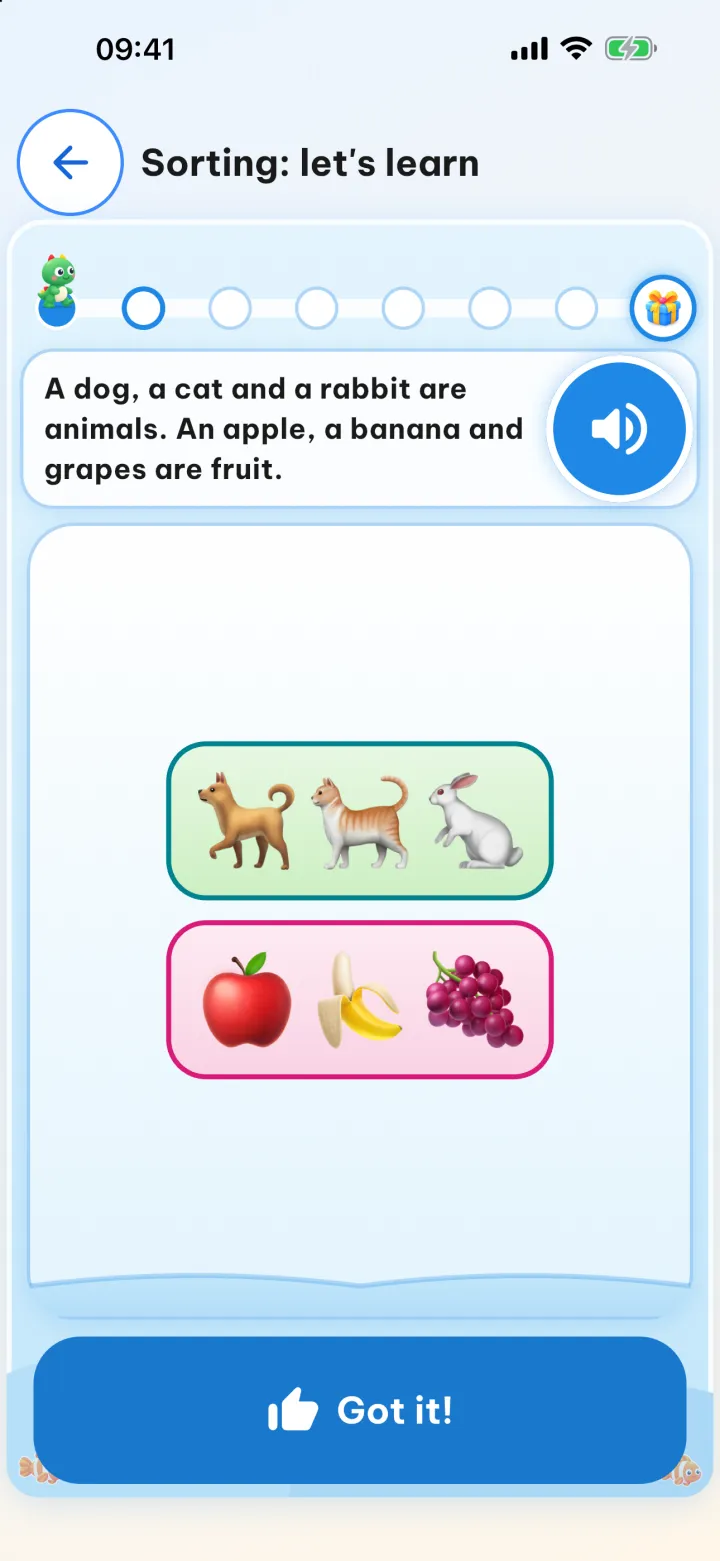
- Learn with eyes and ears, not text. Young children can't read yet, so every question needs a picture and needs to be read aloud.
- See how it's done first, then try. A three-year-old can't work things out from an explanation alone; they need to see the answer once.
- Small steps. Start with two colours and three choices; move to three-item patterns and four choices once your child is confident.
- Play, with an adult guiding. A meta-analysis of 17 studies (Skene et al., 2022) found that "guided play", play that an adult gently steers towards a learning goal, had a positive effect on early maths skills and shape knowledge compared with direct instruction.
- No pressure from scores. Mistakes are a normal part of learning. Offer a hint, show how, let your child try again; skip the red crosses.
Thinking math in Dino Kids
The Math subject in Dino Kids has a new Thinking math tile  , made for children aged 3–6. From the home screen, your child taps Math, then Thinking math. Thinking math runs separately from the counting and sums lessons, so your child doesn't have to finish counting before starting.
There are 6 units and 28 lessons:
 Patterns: find what comes next, find the missing piece in the middle, fill in the last two spaces, and number sequences that go up or down evenly (in steps of 1, 2, 5 or 10) within 20.
 Sorting: find the odd one out, find the exact match, pick everything in one group (things that fly, things that live in water, fruit, vehicles…), and match things that go together.
 Position and space: on, under, in, out, next to; left and right as your child sees the screen; which place it is counting from the left.
 Sizes: biggest, smallest, longest, shortest, ordering from small to big, and which one is heavier.
- 🧠 Order and thinking: put an egg, a chick and a hen in order, or a sprout growing into a plant; "the hen goes with corn, so what goes with the dog?"; pick the shape that has the right form and the right colour.
 Big challenge: two mixed review lessons across the units, and a final quiz.
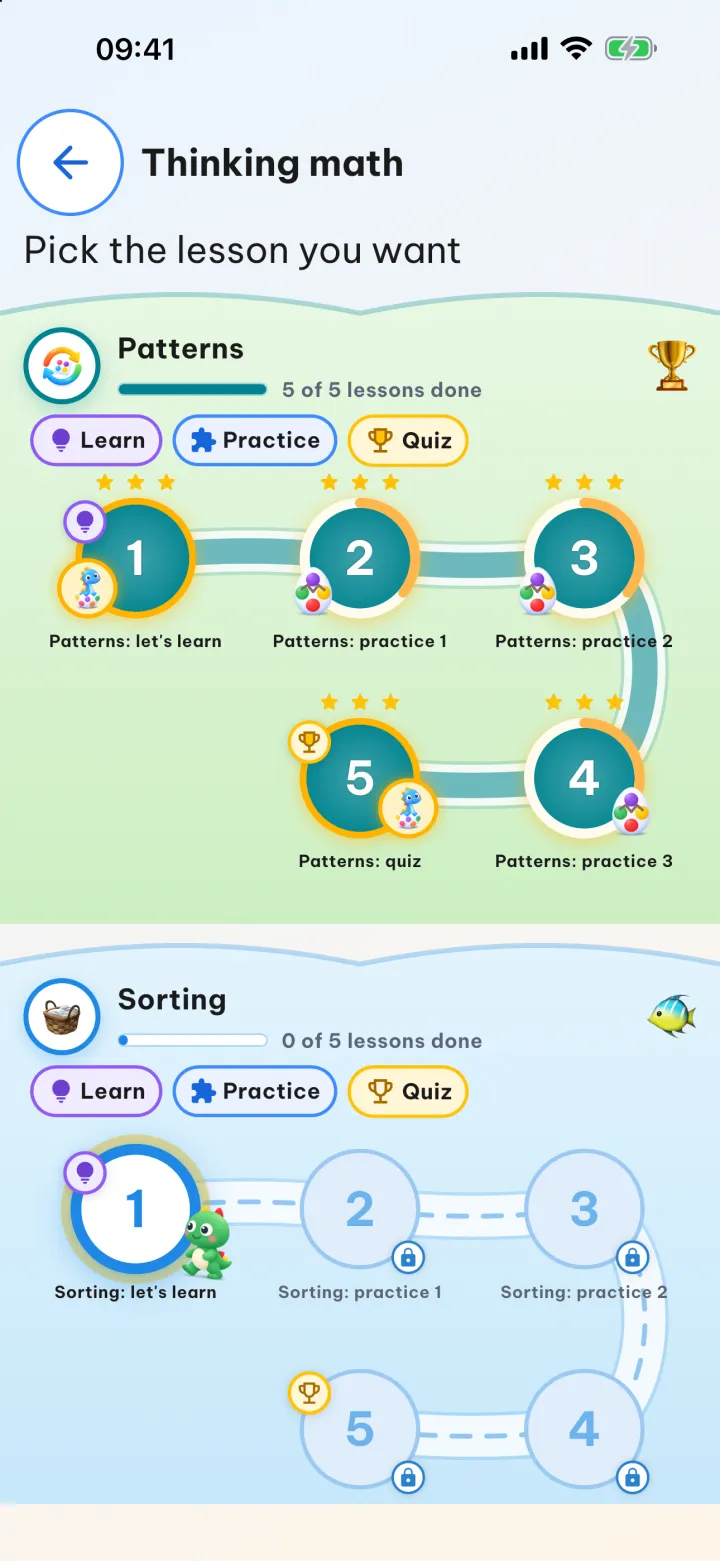
Three kinds of lesson in each unit
- Learn opens each unit: five picture pages, read aloud as soon as they appear. The picture already shows the answer, so the first time your child sees the solution instead of an empty box. Tapping the picture plays it again, and Got it! moves to the next page. Then come two questions for your child to try alone.
- Three Practice lessons go from level 1 to level 3. Level 1 suits three-year-olds: two-colour patterns, three choices, familiar animals. Level 3 is for 5–6-year-olds: three-item patterns, four choices, scenes with more animals.
- A Quiz closes the unit, with questions going from easy to hard. Do well and your child wins a gold trophy; if not, the app says "Try again to win a trophy!". Either way the lesson counts as done and the next one opens: a child is never held back because of a score.
Your child never gets zero stars, and there are no crosses and no red. Questions and explanations come in five languages, Vietnamese, Japanese, English, Korean and Chinese, all read aloud. Finishing a lesson earns a ticket to Playtime, as in the other subjects. To see how far your child has come, open Settings → Learning report, where Thinking math has its own section.
Thinking math at home
The app is one place to start; most of a child's thinking math happens in everyday life. A few games that need no preparation:
- Make a pattern. Lay out spoon, fork, spoon, fork at the table and ask "what comes next?". Swap roles: your child makes the pattern, you guess.
- Tidy up by group. Cars in one box, soft toys in another. Now and then make a "mistake" on purpose for your child to catch.
- Talk in position words. "Teddy is under the pillow", "the ball is to the left of the chair". Older children can quiz you back.
- Compare and line up. Dad's shoe, Mum's shoe, your child's shoe: which is biggest? Line up three cups from shortest to tallest.
- Tell it in order. What did you do first this morning, and what came next?
- Ask "why do you think so?" more often than "is that right?". Hearing your child explain is the best way to learn what they are thinking.
Good to know
- Thinking math is in Dino Kids on the App Store and Google Play. If you don't see it yet, update the app.
- It is free, like the whole app: no ads, no in-app purchases. Dino Kids is a product Digi Dinos makes for the community, not a revenue channel.
- The first lesson is built into the app. The other lessons and their voices download when your child opens them, so the first time needs a connection; lessons already downloaded work offline.
- The questions, explanations and picture sets were written by the Dino Kids team, not copied from any book or app; the pictures are your device's emoji. If a question doesn't suit your child, or you would like another kind of exercise, write to us at dinokids@digidinos.com.
References
- Duncan, G. J., et al. (2007). School readiness and later achievement. Developmental Psychology, 43(6), 1428–1446.
- Rittle-Johnson, B., Fyfe, E. R., Hofer, K. G., Farran, D. C. (2017). Early math trajectories: Low-income children's mathematics knowledge from ages 4 to 11. Child Development, 88(5), 1727–1742.
- Young, C. J., Levine, S. C., Mix, K. S. (2018). The connection between spatial and mathematical ability across development. Frontiers in Psychology, 9, 755.
- Skene, K., et al. (2022). Can guidance during play enhance children's learning and development in educational contexts? A systematic review and meta-analysis. Child Development, 93(4), 1162–1180.