 Dino Kids

Somewhere around preschool, letter tracing books start appearing in the house. One child traces happily for twenty minutes; another does half a page and throws the pencil. A three-year-old wants to "write like her big brother", while a five-year-old still holds the crayon in a fist. Sooner or later every parent asks the same question: when can kids start tracing letters, and how do you get it right from the start?
Our article on how to teach letters to preschoolers covers recognising letters: names, sounds, which ones first. This one is about the hand, and about letter tracing for toddlers and preschoolers in particular. When is the hand ready, how should it hold a pencil, how does a child get from tracing to writing on their own, and what is the difference between tracing on paper and tracing on a screen?
When can kids start tracing letters?
Official expectations put real letter writing later than many parents think. In the United States, the Common Core standards ask kindergartners, at around five and six, to "print many upper- and lowercase letters". The Head Start Early Learning Outcomes Framework, written for children up to five, talks about writing "using increasingly sophisticated marks" rather than neat letters. In England, the Early Years Foundation Stage expects children at the end of Reception, the year they turn five, to write recognisable letters, most of them correctly formed. Before that, drawing, colouring and scribble "writing" are exactly what a three- or four-year-old should be doing.
Age is only a rough guide, though. A better question is: can your child already draw the strokes that letters are made of? A lowercase "a" is a circle and a straight line. A "k" needs slanted lines. An "x" is two slanted lines crossing. If a child can't draw a diagonal yet, tracing an "x" is asking a lot.
Visual-motor tests used by pediatric therapists, such as the Beery VMI, show that children learn to copy shapes in a fairly predictable order:
- around 2 to 3 years: a vertical line, a horizontal line, then a circle;
- around 4 years: a plus sign;
- around 4½ to 5 years: a diagonal line, a square, a cross (x);
- around 5 to 5½ years: a triangle.
Weil and Amundson (1994) followed kindergartners and found that children who could copy the first nine shapes of this test, up to and including the oblique cross, copied letters noticeably better than those who couldn't. That's why many occupational therapists treat "can draw an x" as a practical readiness sign for handwriting.
You can check it at home in a minute. Draw a slow, big "x" while your child watches, then hand over the pencil and ask them to draw one next to it. Two slanted lines that cross in the middle means the hand is nearly there. If not, give it a few more months of drawing, colouring and play dough. That isn't falling behind; it's getting ready.
Pencil grip: from fist to three fingers
The way children hold a pencil changes as they grow, and each stage is normal. Schneck and Henderson (1990) observed 320 children aged three to seven and described how grip moves step by step toward a mature, flexible three-finger hold. The usual progression looks like this:
- Fist grip (around 1 to 2 years): the crayon sits in the palm and the whole arm moves.
- Fingers on top (around 2 to 3 years): the hand faces down and the fingers press on the pencil.
- Three fingers, still stiff (around 3½ to 4 years): thumb, index and middle finger hold the pencil, but the whole wrist does the moving.
- Three fingers, flexible (around 4½ to 6 years): the fingertips move the pencil while the wrist rests on the table.
By the time a child is tracing letters, you're aiming for stages 3 and 4. A few ways to help without correcting their fingers all session:
- Short crayons and pencils. Snap crayons in half. A short pencil leaves no room for a fist, so the fingers fall into a three-finger hold on their own.
- Draw on a vertical surface. Tape paper to a wall or the fridge, or use an easel. Working upright tips the wrist back into the right position for writing.
- Small-hand jobs. Picking up beads with tweezers, doing up buttons, tearing paper, squeezing play dough: all of it builds finger strength.
- Don't correct every minute. Remind once at the start and praise when they get it right by themselves. Constant correcting can put a child off pencils before the grip has time to settle.
When they sit down to trace, three things matter more than neatness: sitting upright with feet on the floor, the paper straight in front of them with the other hand holding it still, and strokes that go top to bottom and left to right.
From tracing to writing: four steps
Most letter tracing books for preschoolers start with lines and curves, then move on to letters. That order makes sense. But tracing is only the beginning: tracing means following a path that's already there, while writing means remembering the shape and placing the strokes yourself. At home you can move through four steps:
- Watch: you write the letter slowly and talk it through. "Start at the top, go down, then around."
- Trace: your child follows a dotted or faint line, in the right direction and the right stroke order.
- Copy: the model letter sits next to an empty space, and your child writes it there with no path to follow.
- Write alone: no model at all, for example writing their name on a drawing they've just made.
Don't let step 2 go on too long. Once a letter has been traced neatly three or four times, try copying. The copied letter will look worse than the traced one, and that's fine: it's the moment the hand starts learning by itself. James and Engelhardt (2012), the brain-imaging study mentioned in our letters article, point the same way: in children who couldn't read yet, a brain region linked to reading responded more strongly after they had written letters freehand than after tracing or typing them.
Letter tracing for preschoolers: which letters first
The A-to-Z order isn't the easiest order for small hands. Start with the strokes your child can already draw:
- Straight lines: l, i, t, and capitals L, T, I, E, F, H.
- Round curves: c and o, then a, d and g, which all start with that same "c" shape.
- Humps: n, m, h, r.
- Diagonals: v, w, x, y, k, z, and capitals A, M, N, K, X, Y, last of all, at about the age when your child can draw that "x".
Letters in your child's name are the exception worth doing early. They want to put their name on their pictures, and that motivation beats any order. For reading, lowercase letters matter more, since most of the print in picture books is lowercase; capitals are easier to form, though, because they're mostly straight lines. Many families do both side by side, with the capital at the start of the name first.
How long to practice, and signs you're pushing too hard
For a four- or five-year-old, 5 to 10 minutes at a time is plenty, a few times a week. Stop while they still want to do more, not when they're bored. One page done carefully beats three pages rushed.
Slow down if you notice your child:
- tensing their shoulders, pressing so hard the paper tears, or complaining that their hand hurts;
- avoiding the tracing book, crying, or saying "I can't" before trying;
- only tracing when someone sits over them, or only for a reward.
These signs usually mean the hand isn't ready yet or the task is too long, not that your child is lazy. Go back to drawing, play dough and colouring for a while, then try again.
Tracing on paper or on an iPad?
Each does one job well:
- On paper, with a real pencil: the hand learns pressure, friction, and how to hold and steady a pencil. This is what your child will use at school, and no screen replaces it.
- On a screen, with a finger: your child sees straight away where a stroke starts and which way it goes, hears the letter, and can try again instantly without rubbing holes in the paper. A three- or four-year-old who can't hold a pencil well yet can still learn letter shapes and stroke order.
A sensible split is to let the screen teach stroke order and let paper train the hand. Trace an "a" a few times in an app to learn the path, then pick up a pencil and write an "a" on paper. Once your child holds a pencil with three fingers, a stylus feels closer to a real pencil than a fingertip does.
A free tracing app: writing in Dino Kids
The writing section of Dino Kids is built so that a child who can't read yet can practice alone. Families getting ready for school can find more ideas in what parents worry about before kindergarten.
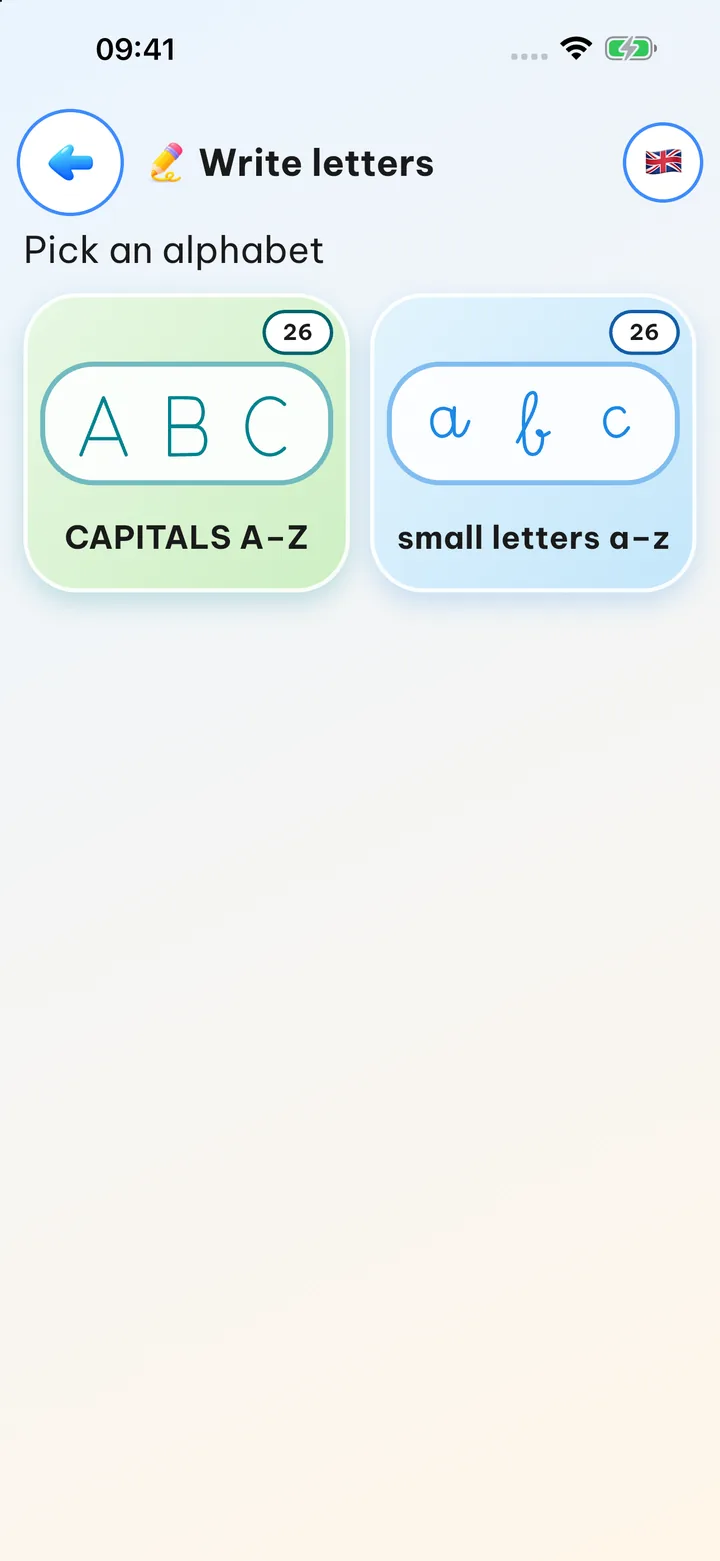
- English letters: 26 capitals and 26 lowercase letters in print. Lessons go from easy strokes to harder ones rather than A to Z, so capitals start with the straight-line letters.
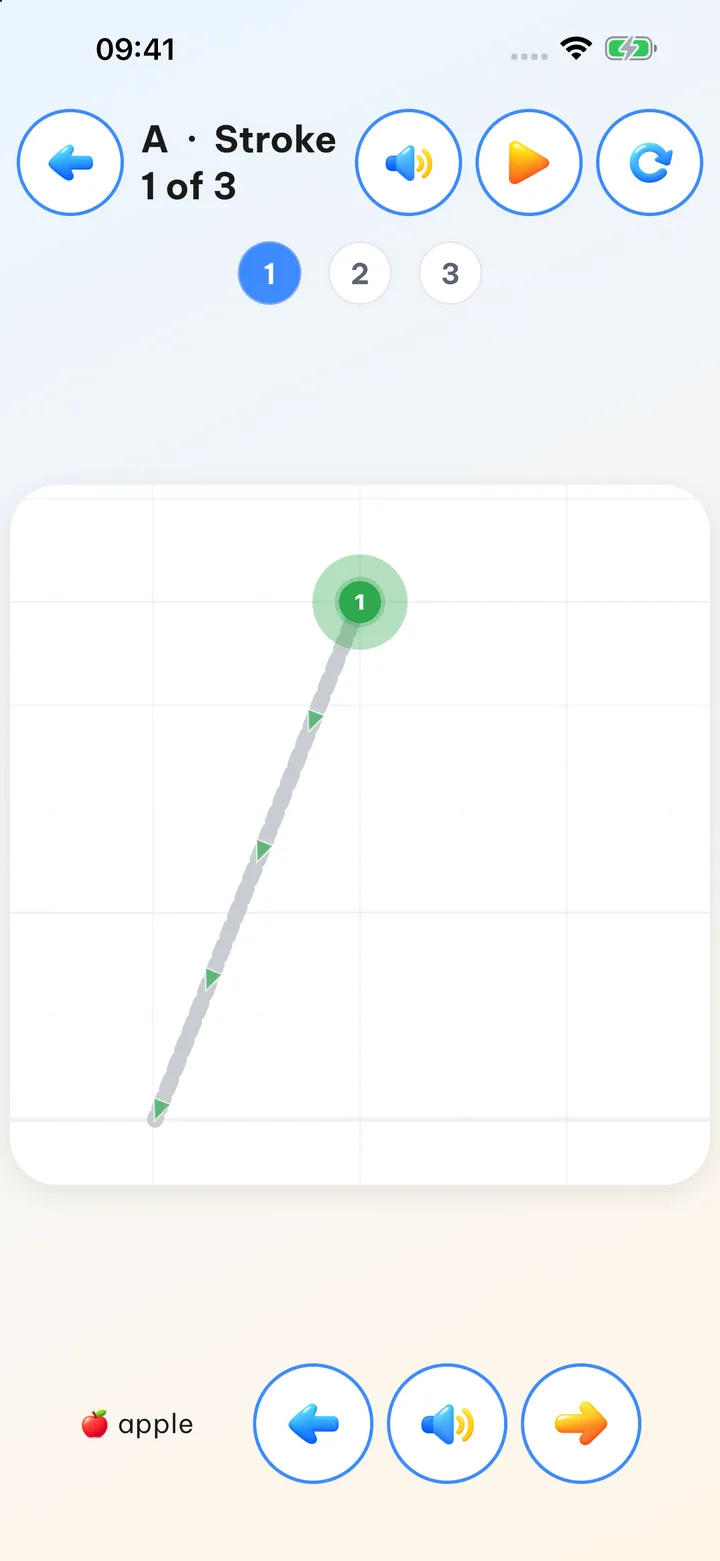
- One stroke at a time: a green numbered dot shows where to put a finger, arrows along the stroke show the direction, and the top of the screen says "Stroke 1 of 3" so your child knows how many are left. A replay button shows the current stroke again, a speaker button says the letter, and an example word sits at the bottom.
- Never zero stars, no red crosses: after several misses the app shows the arrows again and gradually makes the path more forgiving, so your child finishes the letter instead of giving up.
- Finger or stylus: little ones trace with a finger; older children can use an Apple Pencil on iPad.
For children learning more than one language, each language section has its own writing tile that works the same way: Vietnamese letters, hiragana and katakana, Korean Hangul, and the first Chinese characters. The numbers 0 to 9 are traced in the Math section.
What the app can't do for you: a pencil on real paper, and all those moments when your child scrawls their name across a fresh drawing. A screen helps with letter shapes and stroke order; a hand that's comfortable with a pencil still needs paper.
Dino Kids is free, with no ads and no in-app purchases, and needs no account. Most lessons work offline. See the letter tracing page for more. If a letter's strokes look wrong to you, or you'd like another kind of practice, write to us at dinokids@digidinos.com.
References
- Common Core State Standards Initiative, English Language Arts Standards, Language, Kindergarten: L.K.1a, "Print many upper- and lowercase letters."
- Office of Head Start (2015), Head Start Early Learning Outcomes Framework: Ages Birth to Five, Literacy domain, writing.
- Department for Education (England), Early years foundation stage statutory framework: early learning goals for Writing and Fine Motor Skills.
- Weil, M. J., and Amundson, S. J. C. (1994). Relationship between visuomotor and handwriting skills of children in kindergarten. American Journal of Occupational Therapy, 48(11), 982–988.
- Schneck, C. M., and Henderson, A. (1990). Descriptive analysis of the developmental progression of grip position for pencil and crayon control in nondysfunctional children. American Journal of Occupational Therapy, 44(10), 893–900.
- Beery, K. E., Buktenica, N. A., and Beery, N. A. Beery-Buktenica Developmental Test of Visual-Motor Integration (Beery VMI). Pearson. Age norms for copying shapes.
- James, K. H., and Engelhardt, L. (2012). The effects of handwriting experience on functional brain development in pre-literate children. Trends in Neuroscience and Education, 1, 32–42.