 Dino Kids
Your child walks past Grandma's piano and can't resist: a few loud bangs, then a big grin. In the shop they stand at the keyboard display until you drag them away. Sooner or later the question comes up: what age should a child start piano lessons? Is three too young? Is six already late?
Here is the short version. Three and four is the age for exploring the piano through play. Five to seven is when most teachers suggest starting regular lessons. After seven it is not too late at all. The rest of this guide explains why, and covers the signs a child is ready, whether piano makes kids smarter, piano or keyboard for a beginner, how long to practice each day, and piano games you can play at home, even if you don't own a piano yet.
What age to start piano lessons
- Age 3 to 4: exploring. Listening, singing, clapping along to a beat, pressing keys to hear high and low. Children this age can learn a lot, but through play, a few minutes at a time, not through formal lessons.
- Age 5 to 7: starting lessons. This is the window many piano teachers recommend. Hands are big enough to put five fingers on five keys, children can sit and focus for 15 to 20 minutes, and they know numbers and letters, which makes reading music much easier.
- Age 7 and up: not too late. Older beginners often move faster because they understand more and can practice on their own. Plenty of good pianists started well into their school years.
Ages are only a guide. Two four-year-olds can be worlds apart: one sits happily at the keys for fifteen minutes, the other presses three notes and goes off to find a toy car. Watching your child tells you more than their birth certificate.
Can a 3 year old learn piano? Is 4 too young?
Not too young to start, as long as "lessons" look like play. What fits depends on the kind of teaching:
- The Suzuki method, which began in Japan, often starts children at around 3 or 4. Children learn by ear first, the way they learn to talk: listening again and again, copying, with a parent at every lesson and doing the home practice alongside them.
- Group music classes for young children focus on singing, listening, rhythm and a first go at the keyboard, with little pressure on technique. They suit three- and four-year-olds well.
- One-to-one lessons from a method book usually start around 5 to 7, once a child can follow written notes and sit long enough.
For most three- and four-year-olds, a cheerful group class or playing with you at home is a better fit than a 30-minute private lesson. Grade exams and serious practice routines can wait.
Signs your child is ready for piano lessons
- They seek out the piano by themselves, ask "what does this one sound like?", sing along to music.
- They can stay focused for 10 to 15 minutes on something they enjoy.
- They can move fingers one at a time: hold up one finger, fold another, pick things up with fingertips.
- They know left from right and can count to 5 or 10.
- They can follow two- or three-step instructions from an adult who isn't a parent.
- They can take a correction without giving up straight away.
Three or four of these and your child is ready for a beginners' class. Fewer is fine too: keep exploring at home and try again in six months.
Does learning piano make kids smarter?
Parents ask this a lot. In a well-known study, six-year-olds who had a year of keyboard or singing lessons showed a slightly larger rise in IQ than children without music lessons (Schellenberg, 2004). But when researchers pooled dozens of studies and kept only the ones with rigorous designs, the benefit for general intelligence and school grades came out at about zero (Sala and Gobet, 2020).
So don't start piano to boost your child's school results. Start it because music is a joy that can last a lifetime, because practice teaches patience with something hard, and because playing a song you love is a wonderful feeling. Those are reasons enough.
Piano or keyboard for a beginner child?
- Acoustic piano: the real feel of the keys, but expensive, heavy and needs regular tuning. Worth it once your child has been learning seriously for a while.
- Digital piano: weighted keys that imitate the hammer action, a full 88 keys, a headphone socket. The most common choice for children starting proper lessons: cheaper than an acoustic, no tuning, and evening practice doesn't disturb anyone next door.
- Portable keyboard: light keys, lots of instrument sounds and backing rhythms, great fun, but the light keys train fingers to a very different touch from a piano. If the goal is piano lessons, many teachers suggest a digital piano with weighted keys rather than a keyboard.
A three- or four-year-old who is just exploring doesn't need anything expensive. A small keyboard, a grandparent's piano or a piano app with big keys on a tablet is enough to find out whether the interest is real.
How long should a child practice piano each day?
- Age 3 to 4: 5 to 10 minutes, split into two short goes if that's easier. Stop while it's still fun.
- Age 5 to 6: 10 to 20 minutes.
- Age 7 and up: 20 to 30 minutes, growing with the pieces.
A little every day works better than one long session at the weekend. Sitting next to your child, listening and asking "which bit do you like best?" does more than any number of "go and do your piano".
Piano games to play at home before lessons
None of these need any music theory, so any parent can join in:
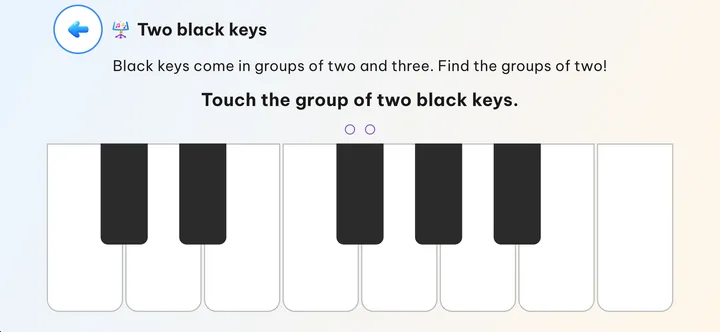
- Find the black-key groups. The black keys come in groups of two and groups of three. Ask your child to touch every group of two, then every group of three. This is the first lesson in many piano books, because the groups of two black keys are how you find C.
- High or low. Play one key on the left and one on the right; your child says which is higher. Then swap roles.
- Clap the beat. Sing a nursery rhyme you both know and clap on every word. Children feel the beat long before they can count it.
- Play a song they already know. When a child knows how a tune goes, they can hear their own wrong notes and fix them. That's why first piano books are full of familiar tunes.
Learn the piano in Dino Kids
Dino Kids has a Music subject with a Learn the piano screen that does exactly the exploring part above, for children from age 3: no real piano needed, no reading music needed. It's on Android phones and tablets as well as iPhone and iPad.
Lessons follow six stages, 27 lessons in all:
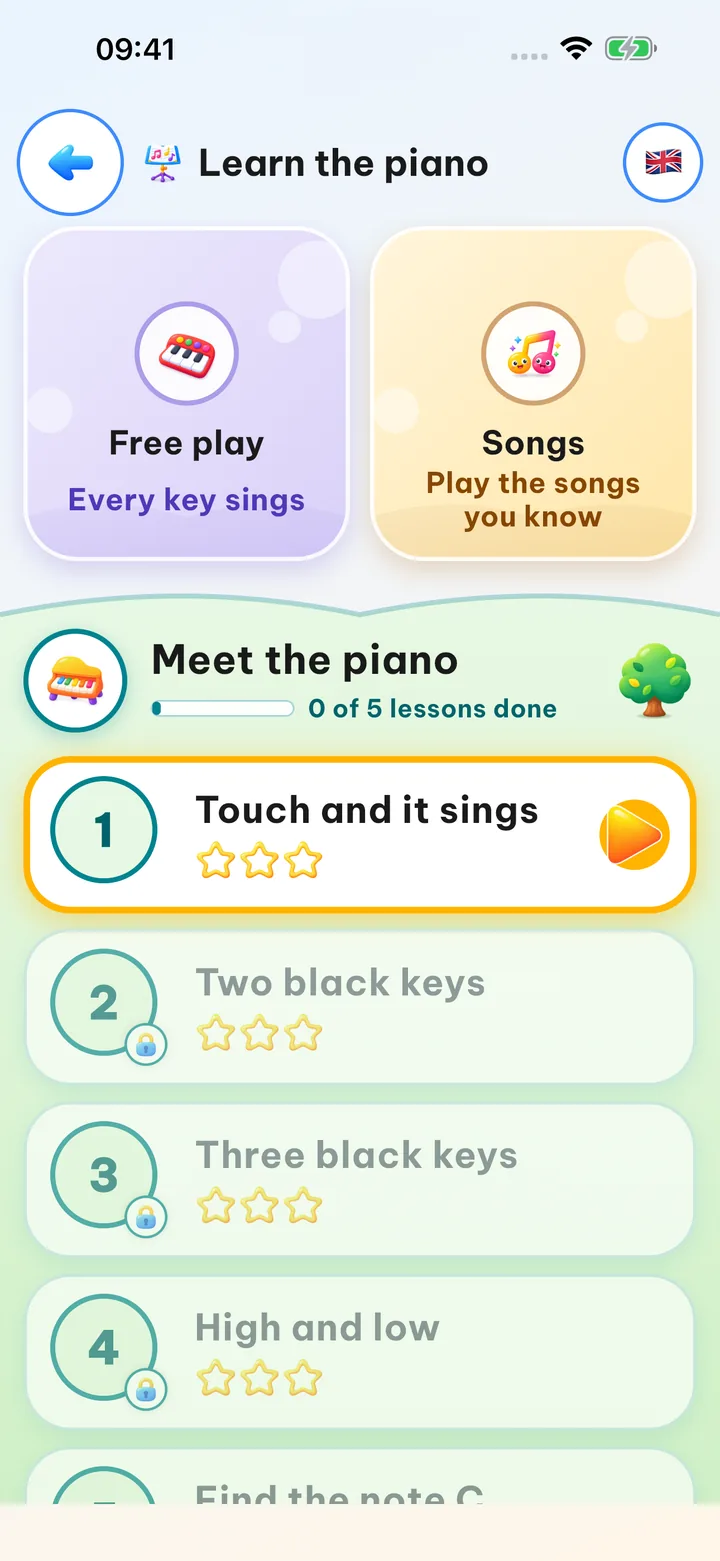
- Meet the piano: Touch and it sings, Two black keys, Three black keys, High and low, Find the note C.
- Five fingers: C D E, finger numbers 1 to 5, five fingers on five keys.
- Beat and rhythm: a steady beat, "ta" and "ti-ti", the long note.
- Three-note songs, such as Hot Cross Buns and Mary Had a Little Lamb.
- All five fingers: leaps, longer phrases, three notes together.
- Moving hands: a full octave, Twinkle Twinkle, London Bridge, Row Your Boat, and two Vietnamese folk songs, Xòe hoa and Lý cây xanh.
Each lesson mixes short exercises: tap the key that lights up; listen and choose whether a sound is high (Bird) or low (Elephant), or whether two sounds are the same or different; tap with the beat. Every lesson has three stars, and stars not yet earned are drawn as outlines, never as crosses.
Big keys for small fingers. A real white key is only about 2.3 cm wide, narrower than the touch area a three-year-old needs on a screen. So the app shows one octave at a time with every key wide enough for a small finger, and turns to landscape when a lesson needs more keys. On tablets the keys are wider still.
Songs. Notes fall onto the key to press, and the note names are shown on the keys (Do, Re, Mi, with small letter names C, D, E). Practice waits for your child to press the right key; Perform keeps the beat going like the real thing. There are three speeds: Slow, Just right and Fast.
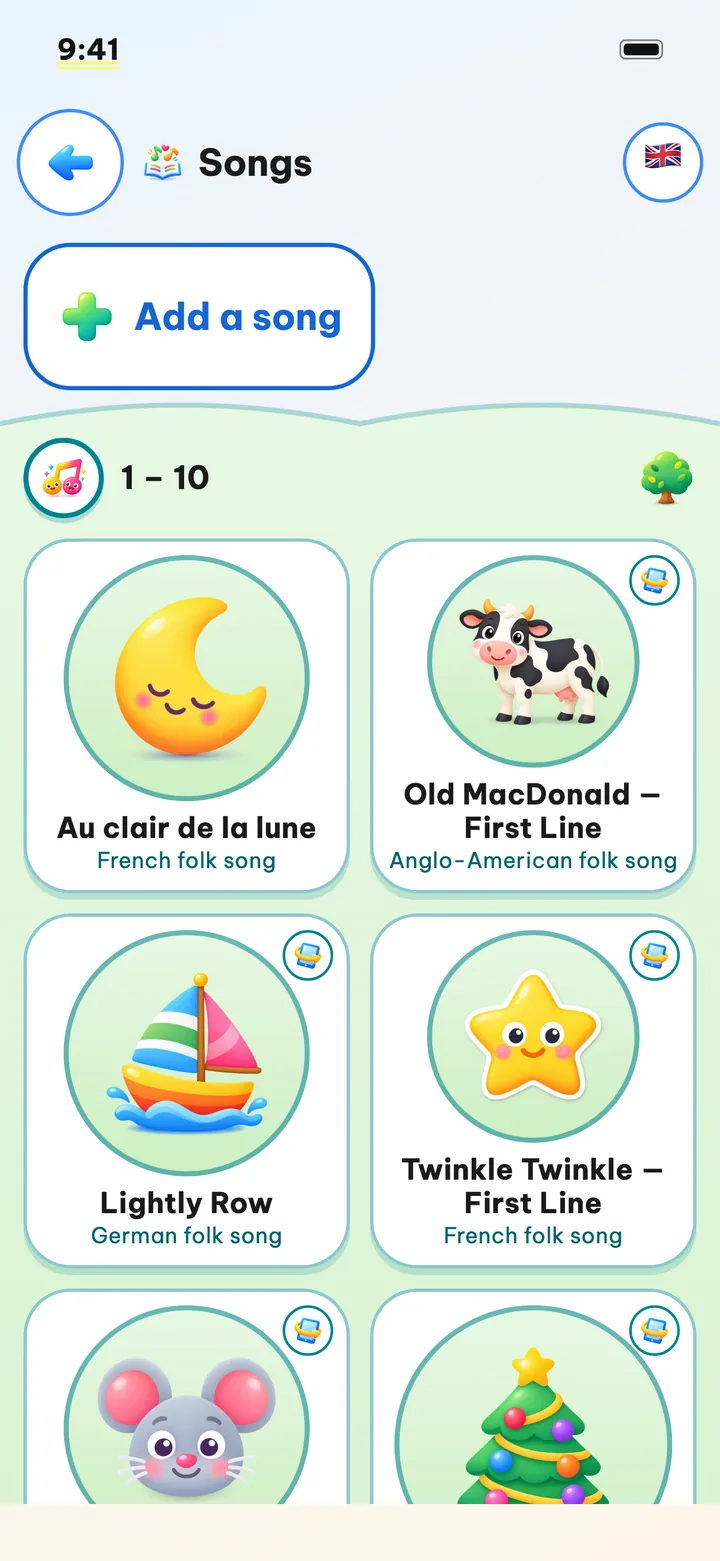
The song shelf is full of tunes your child has probably heard somewhere: folk songs, nursery rhymes from many countries and a few classical pieces that are out of copyright, each with its origin shown. If you can write out music, you can add your own family's songs to Our songs as MusicXML files; see Add MusicXML songs. The Dino Kids piano page has a quick tour of the whole section.
Free play is a piano to play however your child likes: every key sings, arrows move up and down from low to high notes, the plus and minus buttons add or take away keys, and a button can Show note names.
Dino Kids does not replace a piano teacher. It can't correct hand position or teach the weight of a finger on real keys. Think of it as a first step: a way to find out whether your child enjoys the piano, to find C, hear high and low and clap a steady beat before the first lesson, and a place to play when there's no piano at home.
Good to know
- Dino Kids is on Google Play for Android phones and tablets and on the App Store for iPhone and iPad. The piano lessons, Free play and Songs are on both. The song shelf of familiar tunes described above came in version 1.3.9 on iPhone and iPad; the Android version (1.3.6 today) gets it in the next update.
- Music is free, like the whole app: no ads, no in-app purchases, no account needed. The 27 lessons and the piano sounds are built into the app, so your child can play with no internet connection. Dino Kids is a product Digi Dinos makes for the community, not a revenue channel.
- The piano sounds are created by the Dino Kids team, the lessons are our own, and the new song shelf is folk and classical tunes in the public domain. If you're a piano teacher with thoughts on the lesson path, write to us at dinokids@digidinos.com.
References
- Sala, G., and Gobet, F. (2020). Cognitive and academic benefits of music training with children: A multilevel meta-analysis. Memory & Cognition, 48(8), 1429–1441.
- Schellenberg, E. G. (2004). Music lessons enhance IQ. Psychological Science, 15(8), 511–514.