 Dino Kids
You know the scene. The kids' menu arrives with three crayons and a maze on the back, and your four-year-old sets off from the entrance at full speed, straight into a dead end. Crayon up, another path, another dead end. On the third try something changes: they stop, run a finger ahead along the paths, and only then start drawing. That small pause, look first, then go, is exactly what mazes teach.
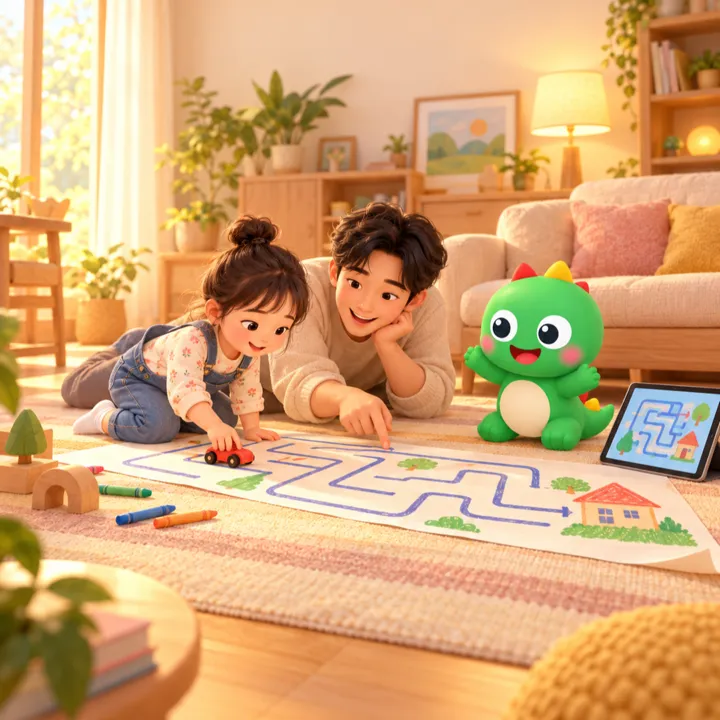
Short answer: yes, mazes are good for preschoolers. They build planning ahead, a sense of space and direction, and steady pencil control, and they teach a child that a wrong turn is just something to undo. A three-year-old can start with very wide, simple mazes; most five- and six-year-olds enjoy real puzzles with branches and dead ends.
This guide covers what mazes help with, which mazes suit each age, how to help a child who gets stuck (without solving it for them), what dot-to-dot adds, maze ideas that need no printer, and at the end the Maze games in Dino Kids, on Android phones and tablets as well as iPhone and iPad.
Are mazes good for kids?
A maze looks like a time-filler, but each one asks a three-to-six-year-old brain to do several hard things at once.
- Planning before acting. To get out, your child has to scan a path with their eyes, hold it in mind, and stop their hand when it is heading for a dead end. Planning, holding information in mind and holding back an impulse are what researchers call executive function, the group of skills most often linked with being ready for school. Psychologists have used mazes to study planning for a long time, precisely because a maze punishes "go first, think later".
- Space and direction. Left, right, up, down, "through the gap and then round the corner". Spatial skills in the preschool years go with later number skills: three-year-olds who are better at copying block models tend to do better on early mathematics (Verdine and colleagues, 2014). And spatial skills can be improved: a review of 217 studies found that practice clearly helps, in children as well as adults (Uttal and colleagues, 2013).
- Pencil control. A paper maze is a lesson in moving a pencil along a narrow channel without touching the lines, which is just what a child needs before writing. Fine motor skills and executive function both predict how children do in their first year of school (Cameron and colleagues, 2012; Grissmer and colleagues, 2010). In England, one of the early learning goals at the end of Reception is to hold a pencil effectively in preparation for fluent writing, and to begin to show accuracy and care when drawing (Department for Education, 2026).
- Small failures that don't hurt. A dead end is not a mistake, just a path that has been tried. Your child learns to go back and try again without anyone telling them off.
Which mazes suit a 3, 4, 5 or 6 year old?
There is no official standard for "how big a maze for which age". The guide below is a rule of thumb many preschool teachers use. The real test is your child: if they finish in a few minutes and want another, the level is right.
- Age 2 to 3: very wide paths, one or two turns, almost no dead ends. The goal is simply to get a finger or crayon from start to finish without leaving the path. Picture mazes (help the puppy find its bone) make the idea clear.
- Age 3 to 4: small grids of about 4 by 4 to 6 by 6 squares, with a few short dead ends. Children start to stop when they see a path is blocked.
- Age 4 to 5: grids of about 7 by 7 to 10 by 10, longer dead ends, real forks in the path. This is when children start to trace ahead with their eyes before drawing.
- Age 5 to 6: 10 by 10 and up, many branches, narrower paths. You can add rules: pick up a treat on the way, or don't lift the pencil.
- Age 6 and up: big mazes, round mazes, mazes you have to remember. Many school-age children love drawing their own mazes to test their parents.
If your child gets cross, gives up or draws straight through the walls, go down a level. If they finish in ten seconds and look bored, go up one.
How to help when your child gets stuck
- Let them steer. Guiding their hand gets them out of the maze but teaches nothing. Ask instead: "Where does this path go?"
- Trace with a finger first. A finger can explore and back out without leaving a mark. Many children relax once they know the crayon only comes out when they are sure.
- Say the route out loud. "Straight on, turn right, oh, dead end, back we go." Talking helps your child hold the plan in mind, and they pick up direction words along the way.
- Try it backwards. If a maze is hard, start at the finish and work back to the entrance. Children are often amazed at how much easier it is, and it is a first lesson in "change how you think when you're stuck".
- Praise the method, not the speed. "You stopped and looked first, that was clever" helps more than "you're so fast".
- Stop while it's still fun. Three or four mazes in a sitting is plenty. Save the rest for tomorrow.
Dot-to-dot: what it adds
Dot-to-dot (connect the dots, joining 1, 2, 3 and so on until a picture appears) teaches something different: the order of numbers. To join the dots, a child has to know that 8 comes after 7, find the 8 among a crowd of dots, and keep the next number in mind. Seeing numbers as places along a line matters for early number learning. In one experiment, preschoolers who played a simple board game with squares numbered 1 to 10 in a row, in just four short sessions, got clearly better at estimating and comparing numbers (Siegler and Ramani, 2008).
Choose dot-to-dot by the numbers your child knows: up to 10 for most 3 and 4 year olds, up to 20 or 30 at 5, bigger pictures once they can count to 100. Have them say each number out loud as they join it, and cover part of the picture so they can guess what is appearing.
Maze ideas at home, no printer needed
- Masking-tape maze on the floor. Tape paths across the living room floor and let your child drive a toy car through, or walk it themselves. Two- and three-year-olds love this.
- Cardboard box marble maze. Glue straws or craft sticks inside a box lid as walls, drop in a marble, and tilt the box to roll it to the finish.
- Chalk maze outside. You draw, your child walks it; the next day, swap roles.
- Squared-paper maze. Shade some squares black as walls. Older children enjoy designing their own and keeping the "answer sheet".
Printable mazes or a maze app?
Both, for different reasons. Paper mazes build pencil grip; a maze app gives a new puzzle every day and tells your child when a path is blocked, with no grown-up needed to check. For screens, the World Health Organization advises no more than one hour of sedentary screen time a day for children aged 2 to 4, and less is better. More on that in how much screen time for a 3 year old.
Mazes in Dino Kids (Android, iPhone and iPad)
In Dino Kids, the Maze lives in Playtime, alongside Join the numbers and Flip cards. Finishing lessons earns play tickets, and each maze costs one ticket. You choose how many lessons earn a ticket, or pick Free play so your child can play without tickets. How tickets work is explained in Dino Kids Playtime.
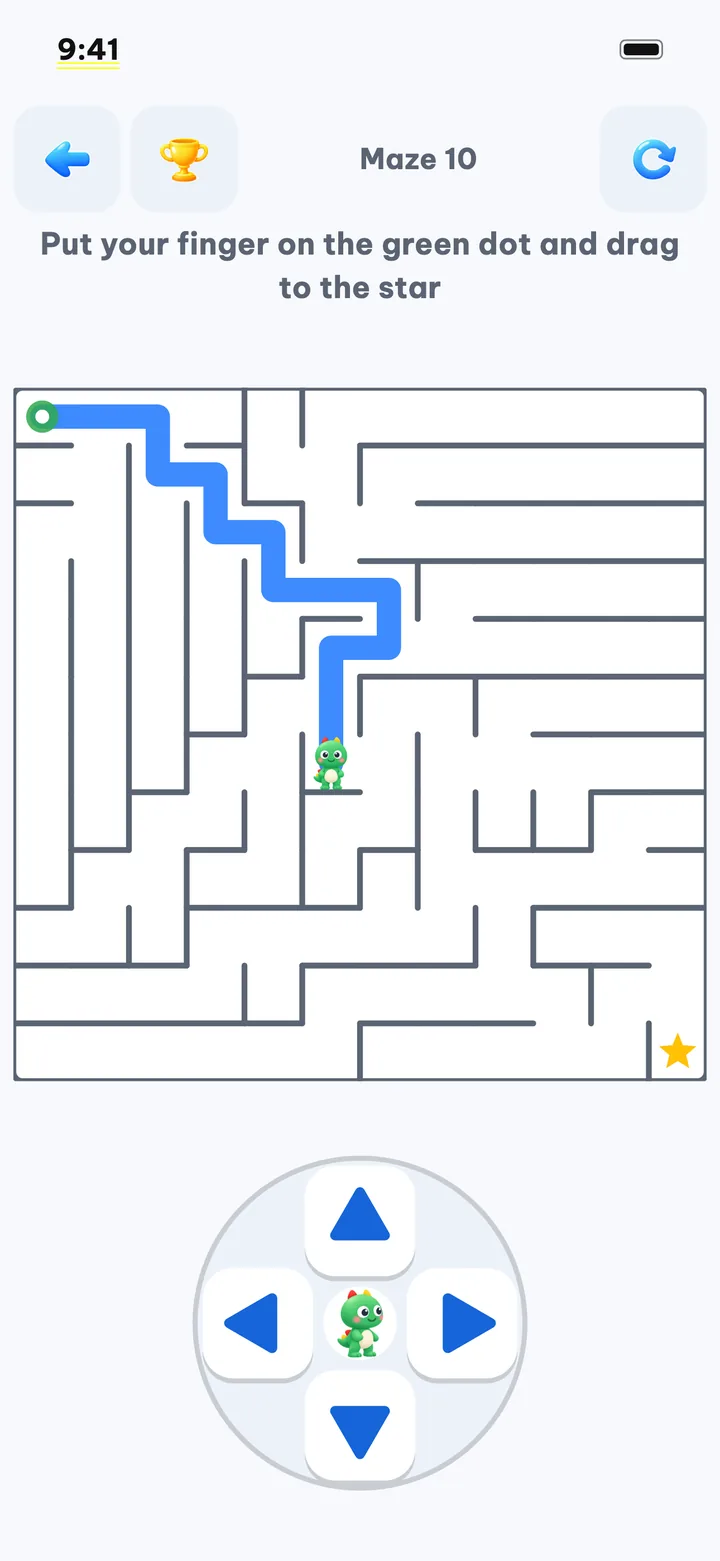
The Day maze has 120 levels. The grid grows from 3 by 3 to 28 by 28 squares, so a three-year-old and a seven-year-old both find a level that fits. Big tablets, iPad or Android, get 30 extra levels with even larger grids.
- Your child puts a finger on the green dot and drags to the star. The line sticks to the paths, and lifting the finger doesn't erase anything. The touch area is sized for a three-year-old's finger.
- There is also a four-arrow pad below the maze, so your child's hand doesn't cover the path.
- Walk into a dead end and the square flashes, with a gentle hint: "Dead end! Go back to a fork and try another way". The line stays; your child taps a point they have already passed and carries on from there.
- Stars go from three down to one depending on how many dead ends were visited. No child ever gets zero stars, there are no red crosses and no timer.
- At the finish, the shortest path appears in red so your child can compare it with their own route.
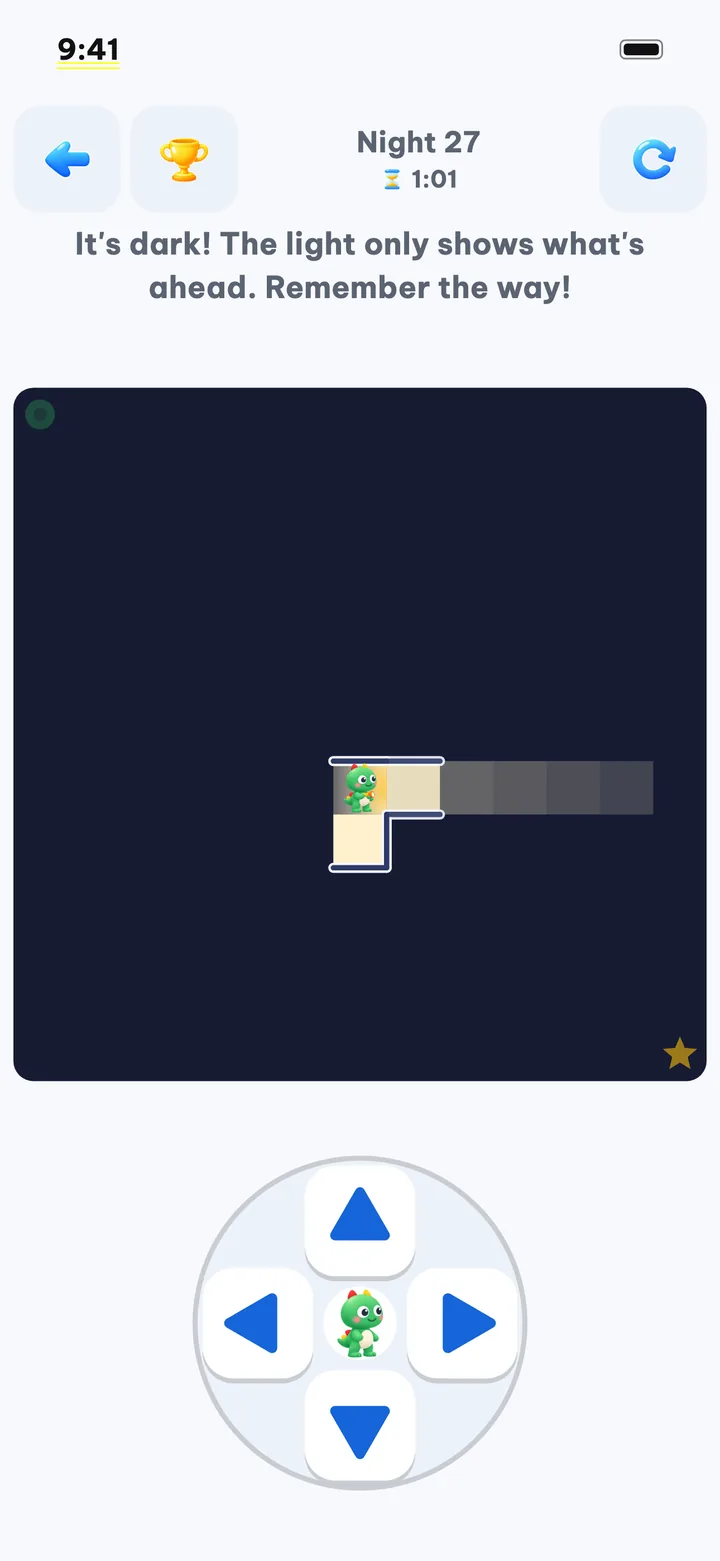
The Night maze is for children who know the day maze well. The Dino carries a flashlight (a torch, for UK readers), your child sees only the corridor just ahead, and no trail is left behind, so they have to remember which way they came. This is spatial memory practice. Going back into a dead end they already visited costs stars, and a clock counts up so your child can try to beat their own best time and see "New record!".
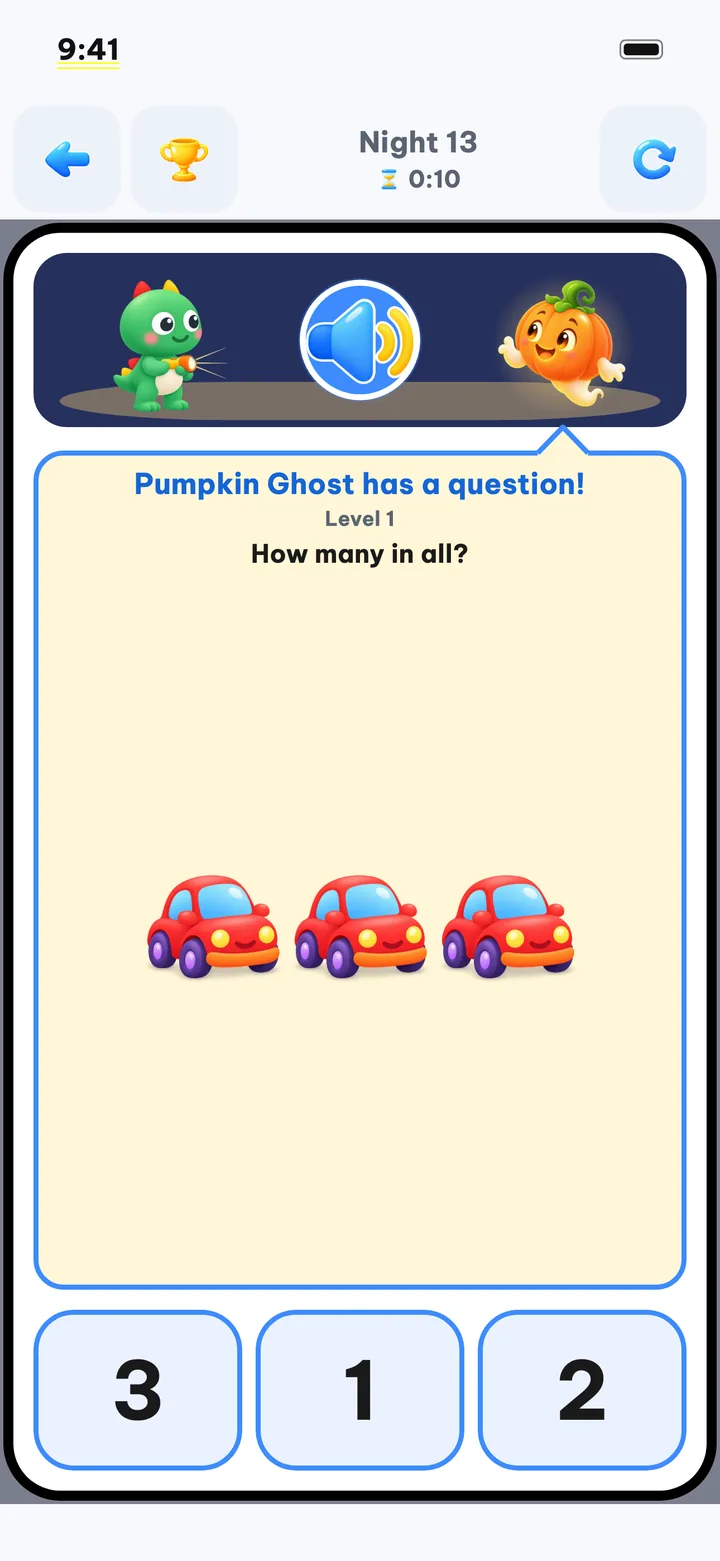
At night-maze dead ends a character asks a question with three answers to choose from, across ten difficulty levels, and the right answer opens the way. The default subject is Math; in Settings, under Night maze challenge, you can switch to another subject or turn the questions off, and see how your child has been answering.
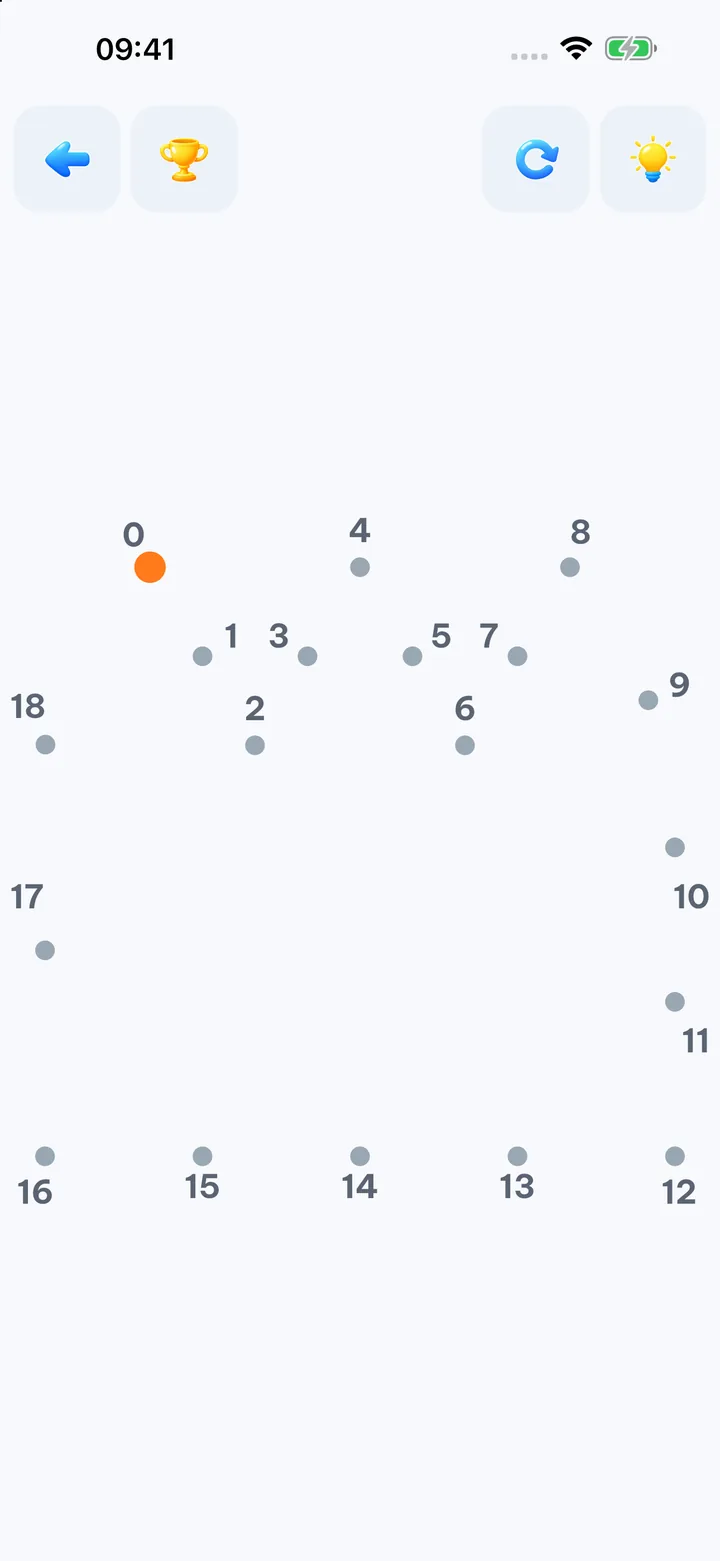
Join the numbers has 100 pictures: the first goes from 0 to 10, the last all the way to 200. Your child taps or drags from number to number, the Dino reads each one aloud in the app's language, and the picture appears at the end. If they can't find the next number, there is a Hint button (using it caps that picture at two stars). For younger children, Connect the dots in the Art subject has 100 pattern pictures with no numbers at all, and needs no ticket.
Good to know
- Dino Kids is on Google Play for Android phones and tablets and on the App Store for iPhone and iPad. The Day maze, Join the numbers and Connect the dots are on both. The Night maze, the dead-end questions, the four-arrow pad, the last 20 challenge levels of the day maze and the 30 big-tablet levels came in version 1.4.0 on iPhone and iPad. The Android version (1.3.6 today) has 100 day-maze levels; the new parts come in the next update.
- The mazes are free, like the whole app: no ads, no in-app purchases, no account needed. The levels are built into the app, so your child can play with no internet connection. Dino Kids is a product Digi Dinos makes for the community, not a revenue channel.
- The levels are generated and checked by the Dino Kids team's own program: every day-maze level has exactly one solution, and difficulty rises steadily from the first level to the last. If a level is too hard for your child, or you have an idea for a new game, write to us at dinokids@digidinos.com.
References
- Cameron, C. E., Brock, L. L., Murrah, W. M., Bell, L. H., Worzalla, S. L., Grissmer, D., and Morrison, F. J. (2012). Fine motor skills and executive function both contribute to kindergarten achievement. Child Development, 83(4), 1229–1244.
- Department for Education (2026). Early years foundation stage statutory framework for group and school-based providers. ELG: Fine Motor Skills.
- Grissmer, D., Grimm, K. J., Aiyer, S. M., Murrah, W. M., and Steele, J. S. (2010). Fine motor skills and early comprehension of the world: Two new school readiness indicators. Developmental Psychology, 46(5), 1008–1017.
- Siegler, R. S., and Ramani, G. B. (2008). Playing linear numerical board games promotes low-income children's numerical development. Developmental Science, 11(5), 655–661.
- Uttal, D. H., Meadow, N. G., Tipton, E., Hand, L. L., Alden, A. R., Warren, C., and Newcombe, N. S. (2013). The malleability of spatial skills: A meta-analysis of training studies. Psychological Bulletin, 139(2), 352–402.
- Verdine, B. N., Golinkoff, R. M., Hirsh-Pasek, K., Newcombe, N. S., Filipowicz, A. T., and Chang, A. (2014). Deconstructing building blocks: Preschoolers' spatial assembly performance relates to early mathematical skills. Child Development, 85(3), 1062–1076.
- World Health Organization (2019). Guidelines on physical activity, sedentary behaviour and sleep for children under 5 years of age.