 Dino Kids
It's a familiar scene at the kitchen table. Your child can chant "7, 14, 21, 28" all the way up, but ask "what's 7 × 8?" and they start again from the top, counting on their fingers. Or the homework sheet comes back with a note about the Year 4 check, and you're not sure where to begin. Either way the question is the same: how do you teach times tables so they stick, without tears on either side?
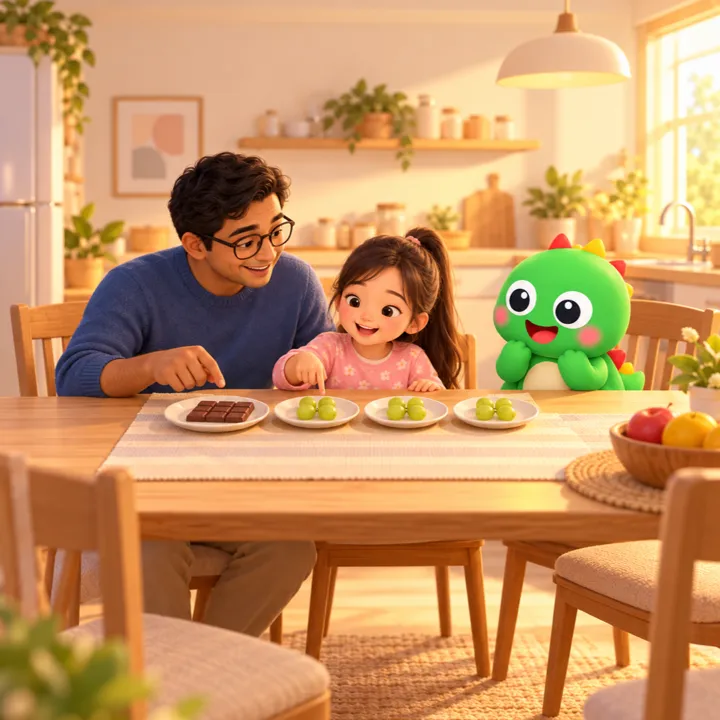
This guide covers when schools in England and the US expect the tables, the easiest order to learn them in, tricks for each table, how to practise so facts last, what to make of timed tests and, at the end, the new Times Tables section in Dino Kids.
When do kids learn times tables?
Later than many parents think, and over several years rather than one.
- England: the national curriculum builds up in stages. In Year 2 children learn the 2, 5 and 10 times tables; in Year 3, the 3, 4 and 8; by the end of Year 4 (age 8 to 9), all tables up to 12 × 12. In the summer term of Year 4, pupils at state schools in England take the Multiplication Tables Check (MTC): 25 questions on screen, 6 seconds each, after three practice questions. The Department for Education says there is no pass mark.
- United States: most children meet multiplication in 2nd grade through arrays and repeated addition. The Common Core standard for 3rd grade says that by the end of the year children should "know from memory all products of two one-digit numbers". Many schools go to 10 × 10 or 12 × 12, depending on the state and the district.
So a child in Year 2 or 2nd grade who knows the 2s, 5s and 10s is right on track. A child who doesn't know the 7s yet in Year 3 is not behind.
Can a five-year-old start? Yes, with the meaning, not the chart. In a small Australian study, 15 of 18 children in their first year of school (average age five and a half) could make equal groups when asked, before anyone had taught them multiplication (Cheeseman and colleagues, 2020). Sharing biscuits fairly onto plates, counting pairs of socks by twos, counting hands by fives: that is real multiplication thinking. Leave the 6s, 7s and 8s for later. For how much maths to do before school at all, see thinking maths for 3 to 6 year olds and kindergarten readiness worries.
Understand first, memorise second
A drilled chart works for a while, but a memorised chant is just a string of sounds: when one line drops out, the child can't find it again. A child who understands what 7 × 8 means can rebuild it: "I know 7 × 7 is 49, and one more 7 is 56."
The building blocks come in a natural order:
- Equal groups. Three plates with four strawberries on each. How many plates? How many on each plate? How many altogether? Let your child set them out and count.
- Skip counting. Instead of counting every strawberry, count a plate at a time: 4, 8, 12. Skip counting by 2s, 5s and 10s comes first, because children already know pairs, hands and tens.
- Repeated addition. 4 + 4 + 4 is the same as 3 × 4. In American classrooms 3 × 4 is read as "3 groups of 4", with the number of groups first.
- Arrays. Lay counters in 3 rows of 4. Turn the paper sideways and it's 4 rows of 3, still 12. This one picture shows why 3 × 4 = 4 × 3.
Only then is it time to learn the facts by heart. By now each line of the table is something your child already understands; the job is just to make it quick.
Which times tables to learn first
Going 1, 2, 3, 4, 5 in number order isn't the easiest route. The order most English schools use works well at home too:
- 2, 5 and 10. Doubles, counting by hands, adding a zero.
- Swapping. Once a child knows that 3 × 7 = 7 × 3, the times tables grid shrinks by almost half.
- 3, 4 and 8. Each builds on doubling.
- 9, which has a finger trick, along with ×1 and ×0.
- 6 and 7 last, then 11 and 12 if your school goes that far.
Here's the encouraging part. Once your child knows the 2, 3, 4, 5, 9 and 10 tables and understands swapping, almost all of the 6s, 7s and 8s are already known: 6 × 3 is just 3 × 6, 7 × 9 is just 9 × 7. Count carefully and only six facts are genuinely new: 6 × 6, 6 × 7, 6 × 8, 7 × 7, 7 × 8 and 8 × 8. Telling your child that before they start the 7 times table takes a lot of the dread out of it.
Times tables tricks, table by table
These are derived facts: ways to work out a fact you don't know yet from one you do. They aren't shortcuts around understanding; they are understanding.
The 2, 5 and 10 times tables
- ×2 is doubling. Every sock has a partner. The answers are the even numbers 2, 4, 6, 8…
- ×10 adds a zero. 10 × 7 = 70.
- ×5 is half of ×10. 5 × 8 is half of 80, so 40. Every answer ends in 5 or 0, and two open hands are a quick way to count in fives.
The 3, 4 and 8 times tables
- ×4 is double, then double again. 4 × 7: double 7 is 14, double 14 is 28.
- ×8 is double three times, or double the 4s: 8 × 6 is 24 + 24 = 48.
- ×3 is double, then one more group. 3 × 6 = 12 + 6 = 18.
The 9 times table finger trick
Hold both hands out, palms down, and number your fingers 1 to 10 from left to right. To work out 9 × 4, fold down the 4th finger. There are 3 fingers to the left of it (3 tens) and 6 to the right (6 ones): 36. It works for every fact from 9 × 1 to 9 × 10, and children love it.
Two patterns help them check: the digits of each answer add up to 9 (3 + 6 = 9), and ×9 is ×10 take away one group, so 9 × 7 = 70 − 7 = 63.
The 6, 7 and 8 times tables
- ×6 is ×5 plus one more group. 6 × 7 = 35 + 7 = 42.
- ×7 is ×5 plus ×2. 7 × 8 = 40 + 16 = 56.
- 7 × 8 = 56 has its own rhyme: 5, 6, 7, 8, as in 56 = 7 × 8.
- 6 × 8 = 48 is double 3 × 8, which is 24.
- 8 × 8 = 64 is double 4 × 8, which is 32.
Pick one trick per fact, not three. Too many methods confuse more than they help.
The 11 and 12 times tables
If you're in England, these matter for the MTC. From 1 × 11 to 9 × 11 the digit repeats: 4 × 11 = 44. For ×12, do ×10 and ×2 and add them: 12 × 7 = 70 + 14 = 84.
How to make times tables stick
Parents often search for how to learn times tables fast. The honest answer is that fast to learn and quick to recall are different things, and the second one comes from little and often, not from long sessions.
- Ask, don't show. Trying to recall an answer does more for memory than reading the chart again. In a well-known experiment, students who tested themselves on a passage remembered more a week later than students who reread it (Roediger and Karpicke, 2006). So ask "what's 6 × 7?" rather than reading the 6s aloud for the tenth time.
- Spread it out. A few facts on Monday, again on Wednesday, then next week. A large review of hundreds of experiments found that spaced practice beats cramming the same amount into one go (Cepeda and colleagues, 2006).
- Mix old with new. Slip a few 2s and 5s in among the 3s, so your child has to think rather than count along.
- Go up, then down, then jumbled. Reciting a table upwards is easy because you can skip count. Down (7 × 10, 7 × 9, 7 × 8…) is harder. Jumbled is what really shows a fact is known.
- Notice the slow ones. If your child always pauses on 7 × 8, that's the one to practise, not the whole 7 times table.
Five minutes a day beats an hour on Sunday. Stop while it's still going well.
Timed tests and the Multiplication Tables Check
Timed tests divide opinion. Jo Boaler of Stanford argued in Fluency Without Fear (2015) that timed maths tests can trigger anxiety in young children and push them towards rote counting instead of number sense. Other researchers and many teachers disagree: they point out that her anxiety evidence is limited, and that short, low-stakes practice against the clock helps many children build quick recall.
A sensible middle path at home:
- At home, put the stopwatch away. Speed grows on its own once facts are well known. Pressure early on mostly teaches children that maths is stressful.
- If your child faces the MTC, be honest and calm about it. Tell them it's 25 questions, a few seconds each, and that it is a check for the school, not a pass-or-fail test for them. A few relaxed rounds of the official-style practice their school provides is plenty.
- Six seconds is enough for a known fact. If a fact needs counting up from the start, it isn't known yet. That's useful information, not a failure.
Times tables games to play at home
No worksheets needed:
- Socks and shoes: count pairs by twos while sorting the laundry.
- High fives: count hands round the dinner table by fives.
- Chocolate bar arrays: a bar of 3 rows by 6 squares is 3 × 6. Who can tell how many without counting each square?
- Backwards rocket: count down a table from ×10 to ×1, then "blast off".
If your family speaks more than one language
Times tables are remembered as words, and those words belong to one language. In a classic study, bilingual adults who learned exact sums in one language answered faster in that language than in their other one (Dehaene and colleagues, 1999). So practise mainly in the language your child is taught in at school. Knowing the tables in your home language too is a lovely bonus, but treat it as a second set to learn, not a translation.
Times Tables in Dino Kids
Dino Kids now has a Times Tables section. Open the app and go to Math, then Times Tables. The tile's hint reads "Groups, skip counting, then tables — from age 5", and that's the route it follows: 10 units and 48 lessons, built in the order above.
- Equal groups: plates with the same number on each.
- Counting by 2s, 5s and 10s: a frog jumping along a number line.
- Times is adding again: repeated addition.
- The 2 times table.
- The 5 and 10 times tables.
- Swapping and arrays.
- The 3 and 4 times tables.
- The 9 and 1 tables, and 0, with the finger trick.
- The 6, 7 and 8 tables, where Dino tells your child "Only 6 new facts are left!"
- Know them all: mixed reviews and a final quiz.
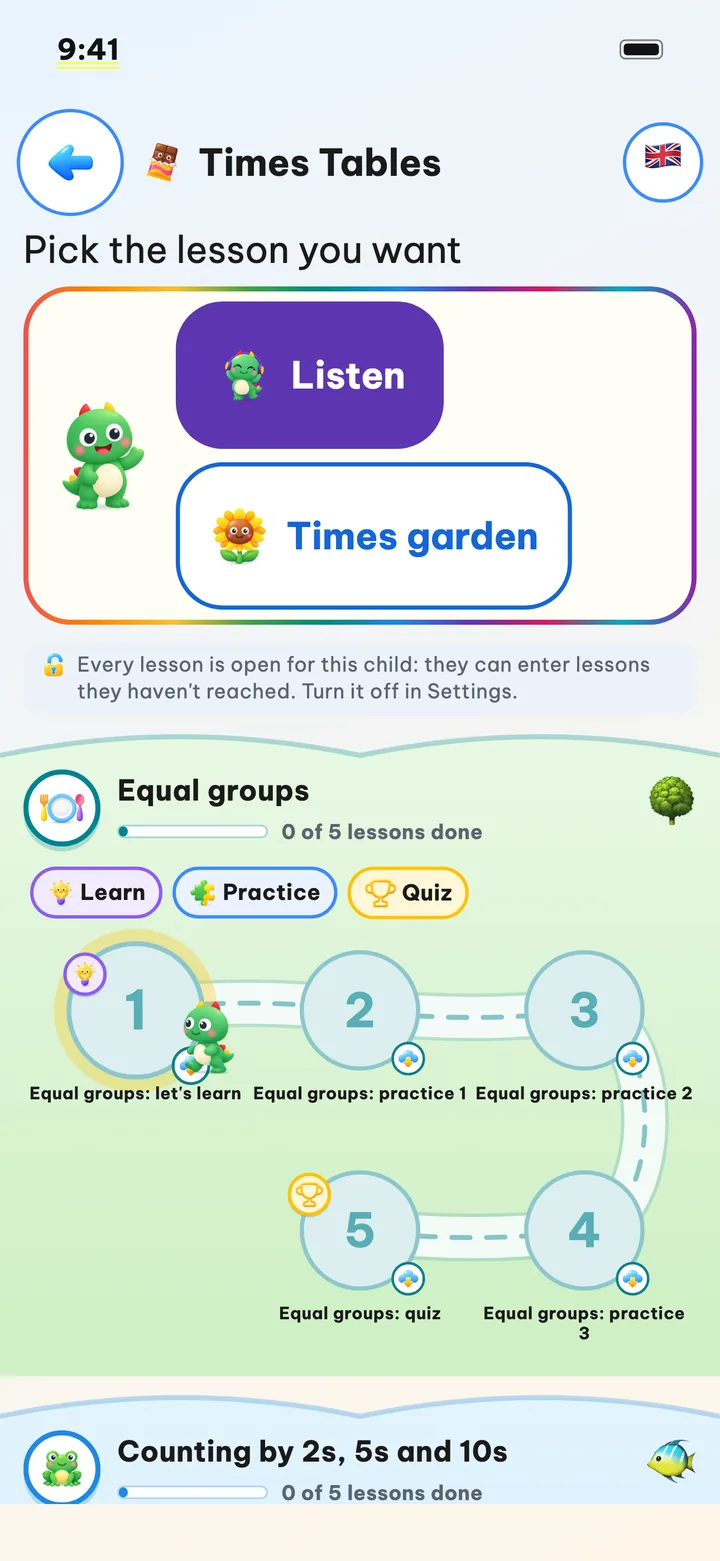
Questions are read aloud, so children who can't read well yet can work alone. Wrong options are the mistakes children really make. For 7 × 8 your child might see 49 or 63 (one skip too few or too many) and 48 (a slip into the 6s), so a wrong tap shows exactly where they went off track. In the English version, groups pictures are written the American way, 3 × 4 for 3 groups of 4, but no answer is ever marked wrong because of the order of the numbers.
Read along with Dino
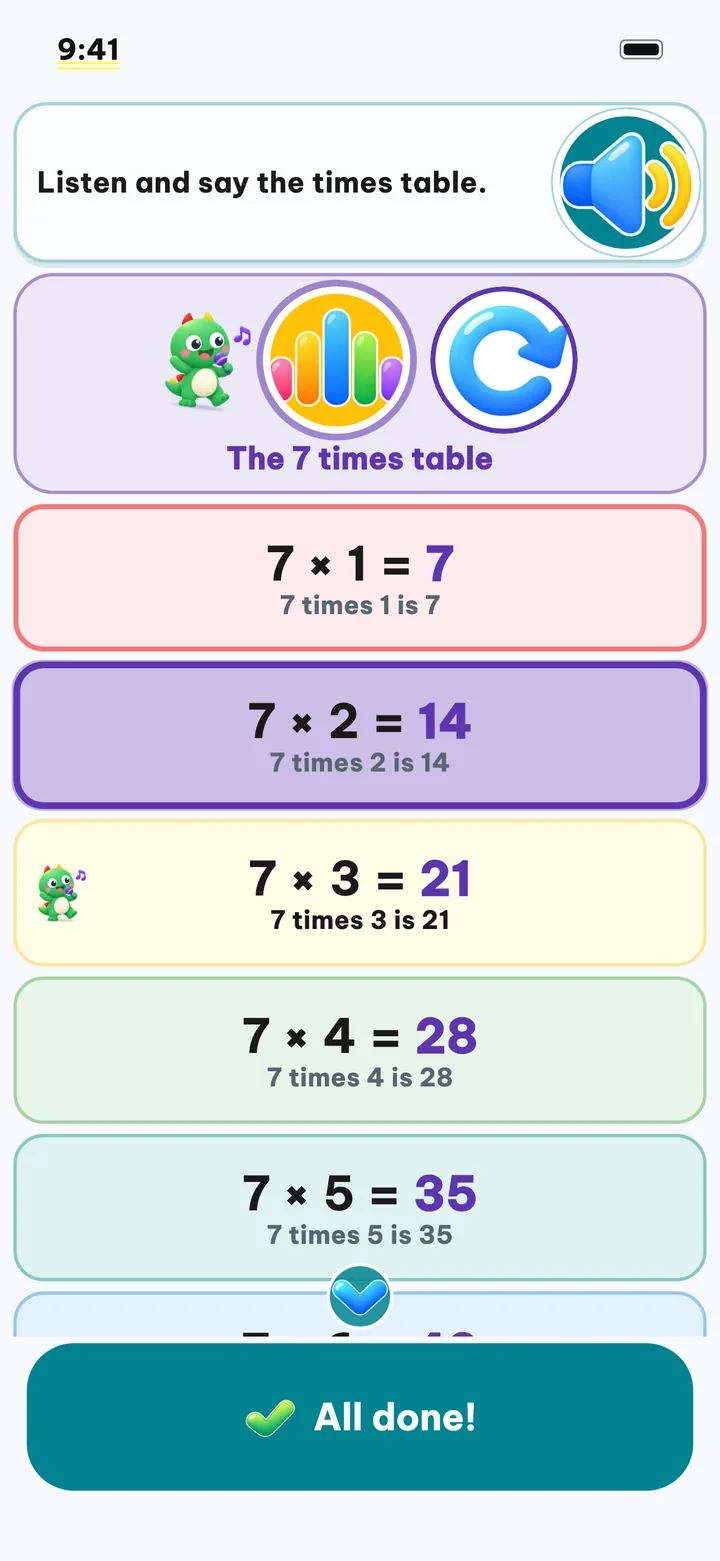
In the units for each table, every practice lesson starts with a chant sheet: "Listen and say the times table." Dino reads each line, "7 times 8 is 56", the line being read lights up, and your child can tap any line to hear it again and say it along. Some lessons go up the table, some go down. Each table has its own colour everywhere in the section, so a child who can't read "The 7 times table" yet still knows it as the purple one.
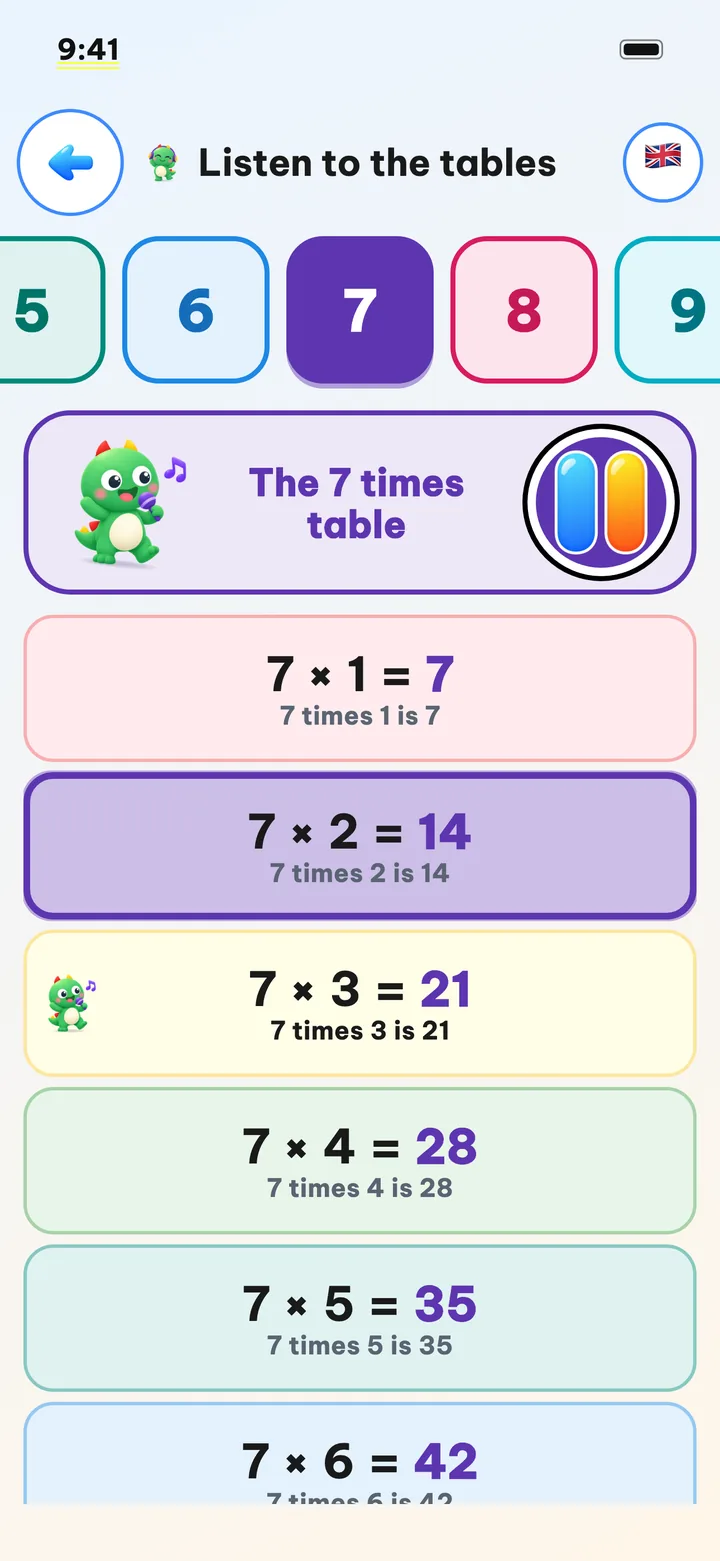
The Listen button on the map opens Listen to the tables. Pick one colour, or All, and Dino reads that table, or all ten in a row, on a loop until you press pause. Your child can build or draw while the facts play.
The Times garden
Lessons are marked lesson by lesson, but knowing a fact by heart is about each fact over many days. So in the Times garden, every fact is a plant on a 10 by 10 grid. Answer it right first time and quickly (within about five seconds) and it grows a step, from sprout to sunflower; right but slow and it stays put; a wrong answer sends it back to a sprout. Plants never wilt and nothing turns red.
When some facts are due again (after 1, 3, 7 and 14 days, the spaced practice from earlier), a Review 5 facts button appears on the map: a short round of up to five questions.
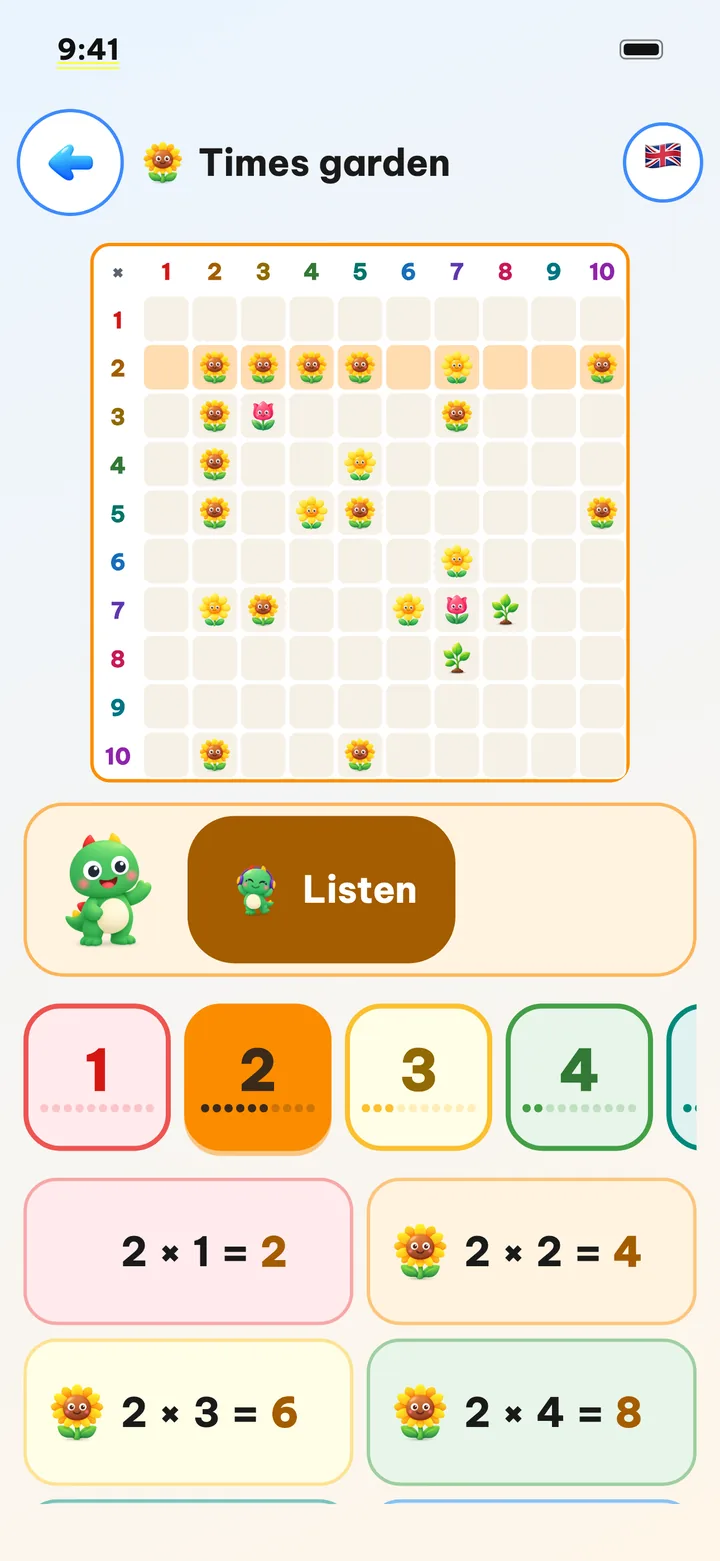
The speed is measured silently to plan reviews. There's no countdown on screen and no "hurry up". Your child never gets zero stars and never sees a red cross. You can see progress in Settings, then Learning report: how many facts are known and met, and which facts get mixed up most often.
For parents in England: Dino Kids covers the tables up to 10, from ×1 to ×10. It doesn't teach the 11 and 12 times tables yet, so for the MTC you'll want the tricks above or your school's practice for those two.
The app speaks five languages (English, Vietnamese, Japanese, Korean and Chinese), and each one reads the tables the way children say them at school in that language. Switch the app language and the chant switches with it. There is also a printable times tables chart from 1 to 10 on our website for the fridge.
Good to know
- Times Tables is in Dino Kids on the App Store for iPhone and iPad, from version 1.3.9. An Android version is coming later. If you don't see the tile yet, update the app.
- Like the rest of Dino Kids, it's free, with no ads and no in-app purchases, and it doesn't need an account.
- Lessons and the voice download the first time your child opens them, so you'll need a connection once. After that they work offline.
- Questions, explanations and pictures are written by the Dino Kids team. The app doesn't use anyone's times tables songs. If a question doesn't feel right for your child, or you'd like another kind of practice, write to us at dinokids@digidinos.com.
References
- Department for Education (2022). What is the multiplication tables check and why is it important? The Education Hub.
- Common Core State Standards Initiative. Grade 3, Operations and Algebraic Thinking, 3.OA.C.7 and 3.OA.A.1.
- Cheeseman, J., Downton, A., Roche, A., and Ferguson, S. (2020). Investigating young students' multiplicative thinking: The 12 little ducks problem. The Journal of Mathematical Behavior, 60, 100817.
- Roediger, H. L., and Karpicke, J. D. (2006). Test-enhanced learning: Taking memory tests improves long-term retention. Psychological Science, 17, 249–255.
- Cepeda, N. J., Pashler, H., Vul, E., Wixted, J. T., and Rohrer, D. (2006). Distributed practice in verbal recall tasks: A review and quantitative synthesis. Psychological Bulletin, 132, 354–380.
- Dehaene, S., Spelke, E., Pinel, P., Stanescu, R., and Tsivkin, S. (1999). Sources of mathematical thinking: Behavioral and brain-imaging evidence. Science, 284, 970–974.
- Boaler, J. (2015). Fluency without fear: Research evidence on the best ways to learn math facts. Youcubed, Stanford University.