 Dino Kids

Your child rattles through a page of sums, then stops dead at this: "A path is 20 metres long. There's a tree at each end and one every 5 metres. How many trees?" The answer comes fast, it's 4, and it's wrong. There's nothing missing from their arithmetic. The trouble is that nobody has shown them how to think about a problem that doesn't tell you which sum to do.
That's what math puzzles are for (maths puzzles, if you're reading this in the UK). This guide walks through the puzzle types children meet most often in primary school, with an example of each, and how to teach them at home without taking over. The second half is a detailed tour of Challenge in Dino Kids: all 29 topics, and how a child is led from a first look to solving on their own.
Why math puzzles do something worksheets can't
On a worksheet of 20 additions, the page has already told your child what to do. In a puzzle, working that out is the job. Curriculum writers on both sides of the Atlantic care about this. The first of the Common Core's Standards for Mathematical Practice is about making sense of problems and persevering with them: looking for a way in, trying a simpler case, changing course if needed. England's National Curriculum for mathematics has three aims, and alongside fluency sit reasoning and problem solving, including non-routine problems broken down into simpler steps.
Puzzles also teach what to do when stuck. Knoblich and colleagues (1999) used matchstick arithmetic to study this moment, and found that a person stuck on such a puzzle moves on by changing how they see the problem, dropping an assumption they didn't know they'd made. A child who learns that being stuck is a normal part of the work has learned something useful.
Six kinds of math puzzles for kids to try at home
Matchstick puzzles
Lay out this sum with real matchsticks or toothpicks, digits made of straight sticks like a digital clock: 6 + 4 = 4. It's wrong. Move one stick to make it true.
There are two answers. Move the middle stick of the 6 up to the top right and the 6 becomes 0, giving 0 + 4 = 4. Or take the upright stick from the plus sign and add it to the 6: now you have 8 − 4 = 4. Most children start by trying to change the answer, and the leap comes when they realise the plus sign can change too.
Planting trees (the fence post problem)
Back to the path: 20 metres, a tree every 5 metres, a tree at both ends. Dividing gives 4, but that's the number of gaps. There's one more tree than gaps, so the answer is 5. Programmers call this the fence post error, and adults make it too. Have your child draw a line with marks on it, or use fingers: five fingers, four gaps.
Age puzzles
"Mia is 7 and her brother is 3. How old will her brother be when Mia is twice his age?" The key idea is that the difference in age never changes. Write two rows of numbers, adding one to each, and let your child find the place where one is double the other: 8 and 4.
Working backwards
"Dino had some apples. He ate 3, then picked 5, and now he has 9. How many did he start with?" Begin at the end and undo each step, turning every action into its opposite: take away the 5, put back the 3. That gives 7. George Pólya's How to Solve It lists working backwards among its classic strategies, and it's a good way into the missing number problems England's curriculum uses from the first years of school.
Sum and difference, with a bar model
"Two boxes hold 40 marbles in all. One has 4 more than the other. How many in each?" Draw two bars, one a bit longer. Cut the extra 4 off the long bar: 36 left, shared equally, makes 18. Put the 4 back and the bigger box has 22. If your child's school teaches maths mastery you'll know this as the bar model; Common Core materials call the same picture a tape diagram. Either way, it's algebra without the letters.
Balance scales
Draw a balance with one apple on the left and two plums on the right, then a second balance with one plum on the left and three grapes on the right. How many grapes balance the apple? Swap each plum for three grapes and you get six. Swapping things that weigh the same is a first taste of how an equation works.
How to teach math puzzles at home
- Draw it first. A line of trees, two bars, two rows of ages. Most of these puzzles get easier as soon as they're on paper.
- Try smaller numbers. If 20 metres feels big, try 10. The Common Core describes exactly this habit of trying simpler forms of a problem.
- Wait before you help. "What do you know so far?" helps more than a hint.
- Then show one worked example. Sweller and Cooper (1985) found that learners who studied worked examples in algebra went on to solve similar problems faster and with fewer errors. Follow up with a near copy of the problem.
- Mix the types. Rohrer and colleagues (2015) found that seventh graders who practised mixed sets, choosing the strategy for each problem, scored higher on later tests than those who practised one type at a time.
- Praise the method. "You drew it and found the gaps" tells a child what worked.
If you're after easier starting points, our guide to thinking math for kids from age 3 covers the groundwork, and how to teach times tables helps with the arithmetic these puzzles lean on.
Challenge in Thinking math
Thinking math in Dino Kids has two paths side by side: Basics, for first steps with patterns and sorting, and Challenge, with a map of its own for puzzles like the ones above. The scale of Challenge, counted from the lesson files themselves:
- 29 topics and 198 lessons.
- 4,989 questions and explanation pages, 591 of them explanation pages.
- Questions, explanations and every How to walk-through read aloud in five languages: Vietnamese, Japanese, English, Korean and Chinese.
All 29 topics are in the app today.
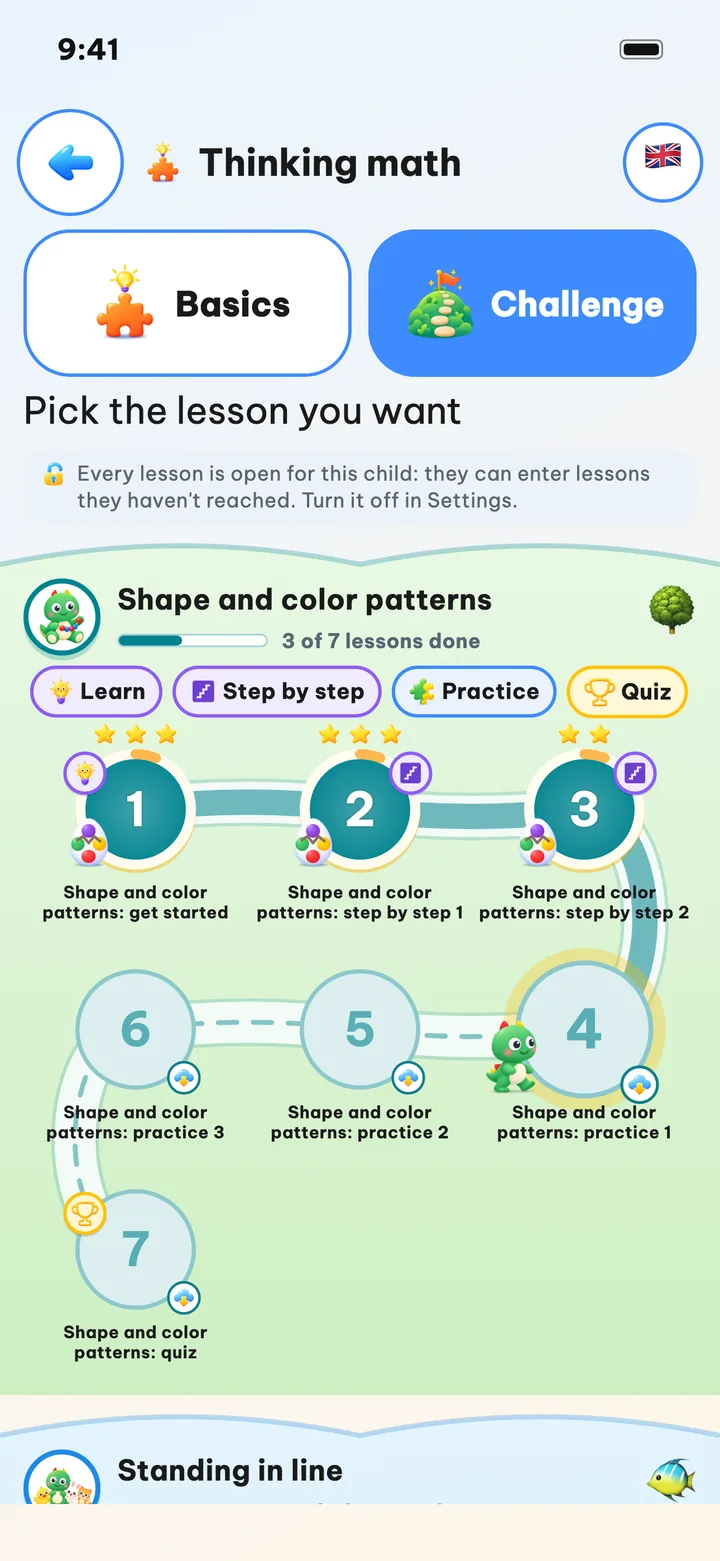
All 29 topics, with a real question from each
The topics aren't labelled with an age or a school year, in the app or here. They're the problem solving types familiar from primary school, and we've grouped them below to make the list easier to read.
Shapes, patterns and data
- Shape and color patterns: "The number of pictures in each box follows a rule. Which box goes at the question mark?"
- Standing in line: "Counting from the left, what place is the kid with the yellow glow?"
- Counting shapes and lines: "How many triangles are in the picture?"
- Sorting and Venn diagrams: "One picture is in the wrong place. Which one?"
- Picture graphs and tables: "Each picture stands for two pieces of fruit. How many pieces of fruit are in the row with the most?"
Clocks and calendars
- Telling the time: "Which clock shows the same time as the digital clock?"
- Time puzzles: "The clock shows when play ended. Play lasted 35 minutes, so what time did it start?"
Sticks and scales
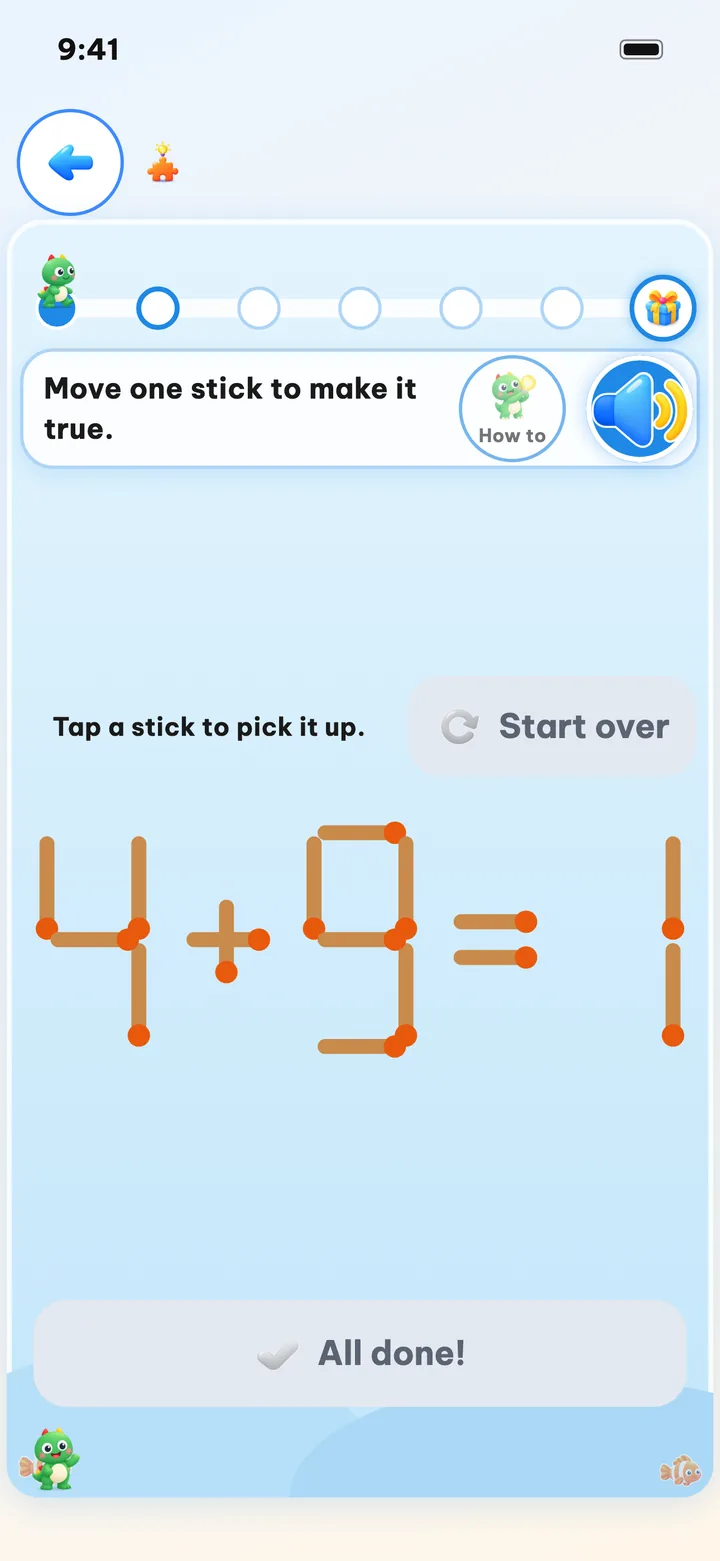
- Matchstick puzzles: "Move one stick to make it true."
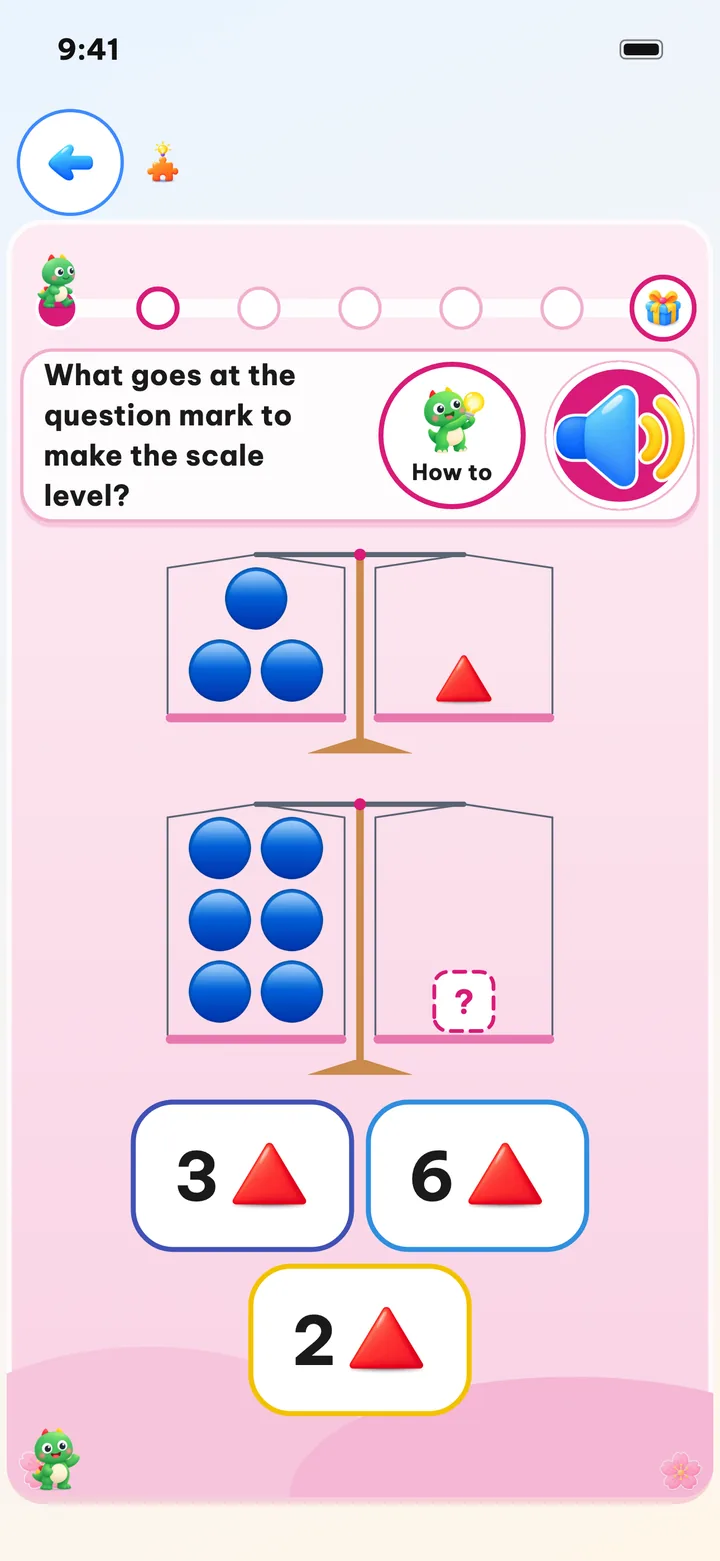
- Balance scales: "What goes at the question mark to make the scale level?"
Numbers with a trick to them
- Number patterns: "Every arc shows the same step. Which one is it?"
- Number rows: next level: "If the row goes on, which place is 33 in?"
- Find the missing number: "Each brick is the two bricks under it added up. What is the missing number in the bottom row?"
- Working backward: "Your marbles double, a friend gives you some, then you drop some. How many did you have at first?"
- Quick sums: "Which way of grouping is right and the quickest?"
- Fractions: "One third of the group is the number shown. How many are there in all?"
- Place value and dividing: "Which digit in the box makes a number that divides exactly by 3?"
- Special numbers: "Two prime numbers add up to this number. Which two?"
- Biggest and smallest: "Use each card once. What is the smallest odd number with three digits you can make?"
Bar models and word problems
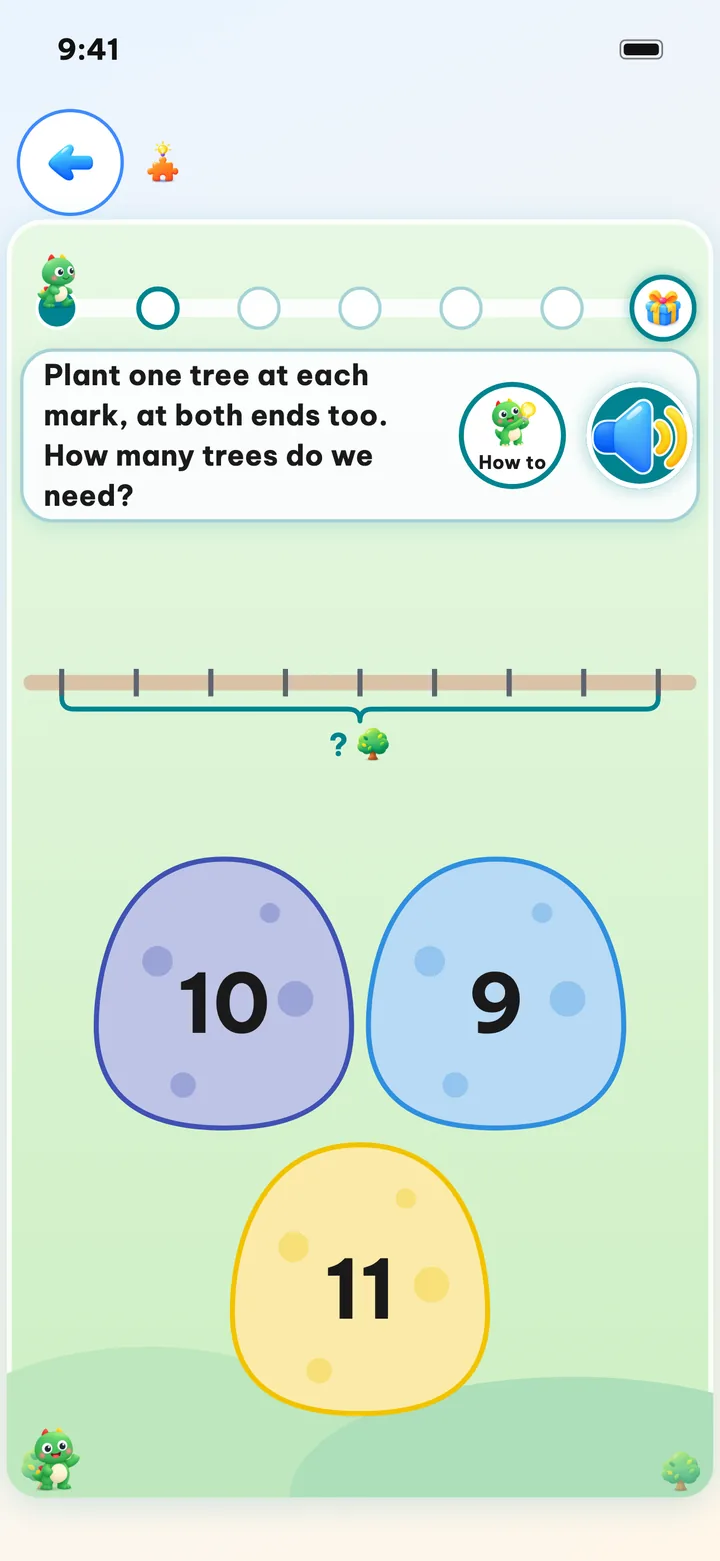
- Planting trees: "Plant one tree at each mark, at both ends too. How many trees do we need?"
- Age puzzles: "The big bracket is both ages added together. The big sister is older by the dashed part. How old is the little brother?"
- One part first: "Each box has the same number of cookies. How many cookies are in one box?"
- Sum and difference: "The big bracket is the sum. The bigger number is 3 times the smaller one. Find the smaller number."
- Averages: "Each bar is one friend's fruit. How many must the friend with more give the other so they have the same?"
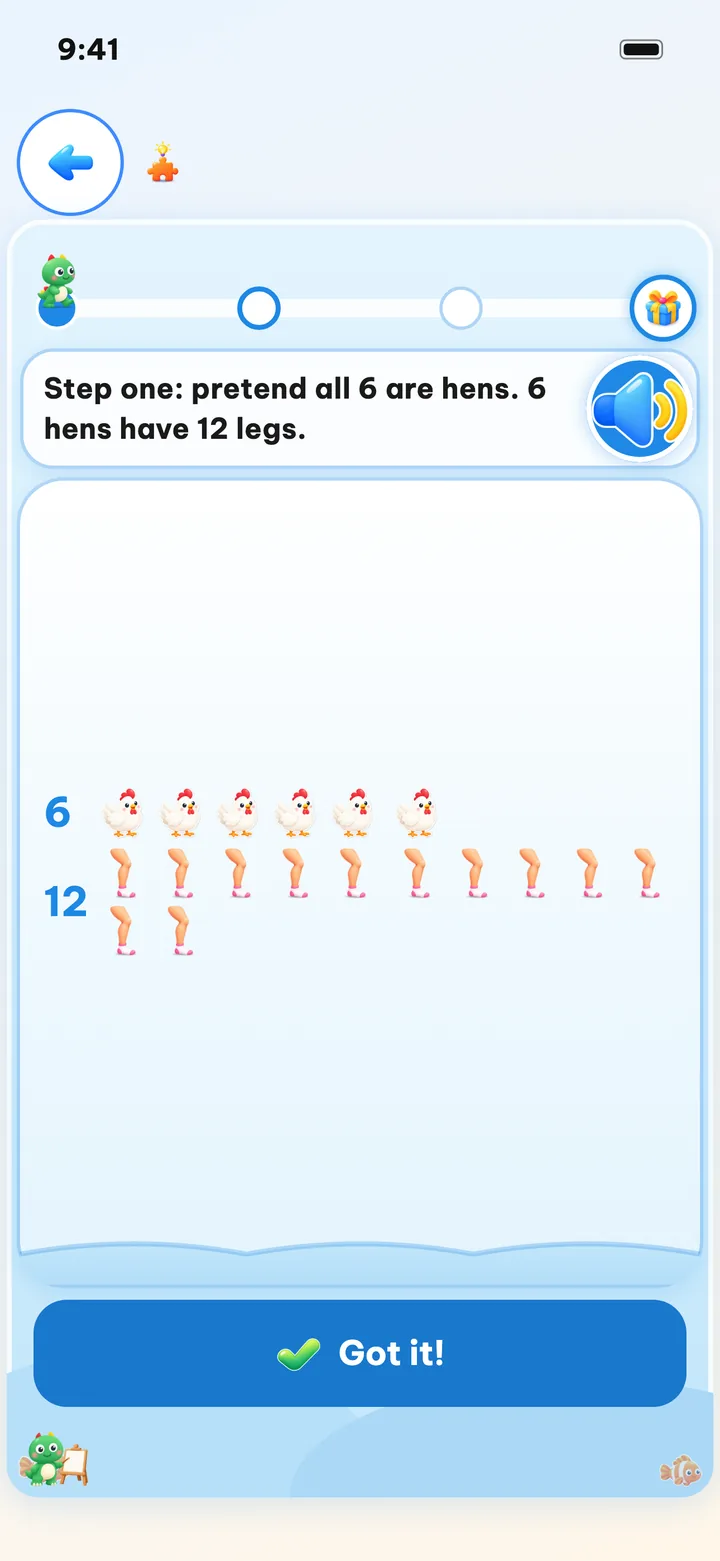
- Hens and rabbits: "Hens have 2 legs, rabbits have 4. How many rabbits are there?"
- Too many, too few: "Share carrots with the rabbits in two ways… Clear carrots are left over, faint carrots are missing. How many rabbits are there?"
- Speed and distance: "Two friends start at the same time from the two ends of the road and go toward each other. How long until they meet?"
- Problems in steps: "There are more oranges than apples, and even more pears than oranges, as the picture shows. How many fruits are there in all?"
Logic
- Who has what: "Each friend picks one thing, and no two pick the same. Who picks the thing in the column with question marks?"
The finale
- The big challenge: two review lessons that mix every topic, and a final quiz.
How one topic teaches: Sum and difference
Inside a topic the support starts high and is taken away bit by bit: Dino shows how, then does it with your child, then lets them do it alone. Most topics have seven lessons in this order: a Learn lesson, two Step by step lessons, three Practice lessons and a Quiz. Here are the first three lessons of Sum and difference, quoted as the app reads them.
Learn: one bar picture, built up page by page. Eight explanation pages all work on the same picture, which grows a little on each page:
- "This is a bar picture. The long bar is the bigger number. The short bar is the smaller one."
- "The extra part of the top bar is dashed. That is the difference."
- "Here the difference is 6, because 17 take away 11 is 6."
- "The bracket around both bars is the sum. 17 and 11 make 28."
- "A sum and difference puzzle gives the sum and the difference. Then you find the two numbers."
- "Take the difference off the bigger number. The sum is 28 take away 6, which is 22."
- "Now the bars match. Half of 22 is 11. That is the smaller number."
- "The bigger number is 11 plus 6, which is 17. Check: 17 and 11 make 28!"
Then come two very easy questions to try: find the smaller number, then the bigger one.
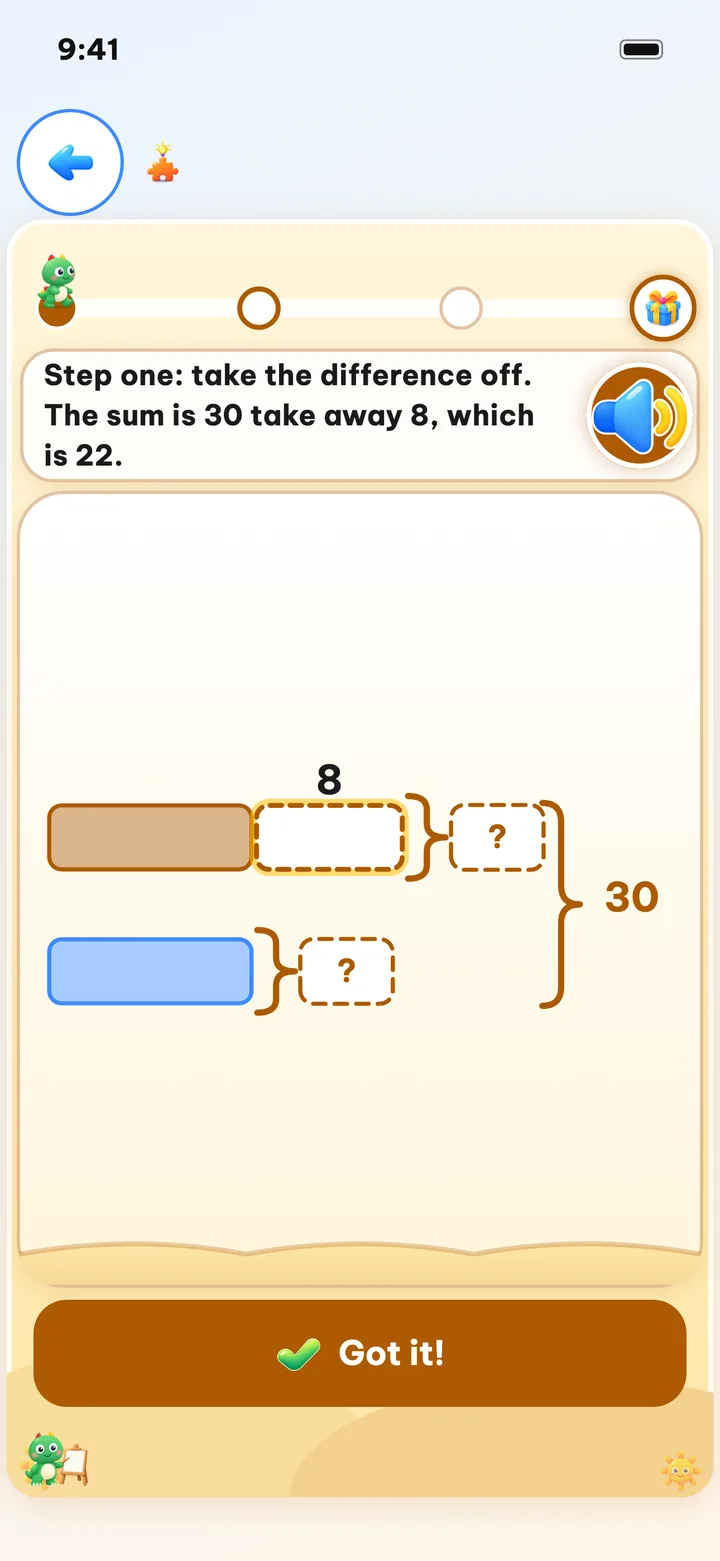
Step by step 1: Dino explains a step, your child does that step. A worked example is cut into steps. "The sum is 30 and the difference is 8. Let's find the two numbers step by step." Dino says, "Step one: take the difference off. The sum is 30 take away 8, which is 22." Then it's Your turn!, on the half-built picture: "The two bars are the same. How much is one bar?" The choices are 22, 12 and 11. Dino goes on, "Step two: the smaller number is 11. The bigger number is 11 plus the difference," and your child finds 19. The lesson checks the answer ("19 and 11 make 30, and 19 take away 11 is 8"), shows another way ("add the difference to the smaller number… half of 38 is 19"), then says "Now try it by yourself" for two more questions.
Step by step 2: the same idea, stretched. "The sum is 24. The bigger number is 3 times the smaller one. Let's find them." "The smaller number is 1 part and the bigger is 3 parts. The sum is 4 parts." Your child finds one part (6), then the bigger number (18), then meets the difference version: "The bigger number has 2 more parts, so the difference is 2 parts. One part is 6." Two questions to try alone close the lesson.
Practice 1, 2, 3. Three practice lessons follow, and the How to button steps back a little each time. In Practice 1 it's always there. In Practice 2 it appears after one wrong answer. In Practice 3 it opens only after your child has answered, to look back over the method.
Quiz. Each topic has a bank of 64 quiz questions of its own. Every quiz draws 8 of them, from easier to harder, and prefers questions your child hasn't had yet, so each attempt is a different set. How to opens only after answering.
The final topic, The big challenge, has two review lessons that mix every topic, and a final quiz of 15 questions drawn from a bank of 252.
What How to looks like
How to walks through the method one step at a time on the question's own picture, with a "Step 1 of 3" counter and a Next step button. On a Sum and difference question ("The big bracket is the sum. The dashed part is the difference. Find the smaller number."), the steps read:
- "Take the difference off the bigger number and the bars match. Take the difference from the sum."
- "The two bars match, so half of the new sum is one bar."
- "So the smaller number is 4."
On Planting trees, How to for "How many gaps are there between the trees?" goes: "Count the gaps in the picture." Then: "There are trees at both ends, so there is 1 fewer gap than trees." Then: "So the answer is 3."
Dino keeps your child company
Dino, the app's dinosaur, is in every lesson. He explains in a speech bubble and points at the part of the picture he's talking about. He says Your turn! when it's your child's go, rests his chin on his hand to think alongside them, and holds up a light bulb when How to opens. After a wrong answer he says Try again!, before a quiz he asks Ready?, and at the end of a topic there's a trophy and "You finished this part!" He never tells a child off.
Matchsticks your child moves
In Matchstick puzzles, many questions aren't multiple choice. The app says "Tap a stick to pick it up." and then "Tap an empty spot to put the stick down." Some puzzles hand over a stick from the box, others ask your child to take sticks away. When the sum looks right, your child taps All done!. On square puzzles any arrangement that works is accepted, so a solution that isn't ours still counts, and Start over puts the board back as it was.
Stars, and no zero
- Looking at How to before answering is allowed. The question is still scored, with 2 stars at most.
- After 2 wrong answers the app gives a hint.
- After 3 wrong answers the app opens How to through to the last step, then moves on with 1 star.
- No question ever ends at zero stars.
Topics don't lock each other. A child who can already read a clock can go straight to Telling the time. Inside a topic, lessons open one after another.
How the questions are made
Every answer in Challenge is recalculated by a program before the lessons ship. The wrong options are the mistakes children really make: counting one too few, counting one too many, stopping one step early. In Step by step 1 above, 22 is what you get if you forget to halve, and when the question asks for the bigger number, 11 is the answer of a child who stopped one step early. The position of the right answer is balanced across each set, so guessing "always the middle one" doesn't work. The lessons, questions and explanations are written by the Dino Kids team, not copied from any book or exam.
An app can't sit beside your child and ask what they noticed, and that's still the part that counts. Try a puzzle in the app, then lay out toothpicks on the kitchen table and make up one of your own. The math page shows the rest of the math in Dino Kids.
Good to know
- Challenge lessons and their voices are downloaded from our server, so the first time needs a connection. New topics arrive the same way, with no app update to wait for.
- Dino Kids is free: no ads, no in-app purchases, no account needed. It's something Digi Dinos makes for the community, not a revenue channel.
- If you don't see Challenge, update the app to the latest version. If you've spotted a puzzle that's wrong or confusing, write to us at dinokids@digidinos.com.
References
- Common Core State Standards Initiative. Standards for Mathematical Practice.
- Department for Education (2013). National curriculum in England: mathematics programmes of study.
- Knoblich, G., Ohlsson, S., Haider, H., and Rhenius, D. (1999). Constraint relaxation and chunk decomposition in insight problem solving. Journal of Experimental Psychology: Learning, Memory, and Cognition, 25(6), 1534–1555.
- Pólya, G. (1945). How to Solve It. Princeton University Press.
- Rohrer, D., Dedrick, R. F., and Stershic, S. (2015). Interleaved practice improves mathematics learning. Journal of Educational Psychology, 107(3), 900–908.
- Sweller, J., and Cooper, G. A. (1985). The use of worked examples as a substitute for problem solving in learning algebra. Cognition and Instruction, 2(1), 59–89.