 Dino Kids

You sit down to draw with your four-year-old. "Draw me a dog," she says, so you do. It isn't much of a dog, but she looks at it, looks at her own page and pushes the crayon away. "I can't. You do it." A year ago the same child filled whole sheets with loops and told you each one was a dog, a car or Grandma. Most parents end up at this table sooner or later, and very few of us were ever shown how to teach a child to draw, so we fall back on "That's lovely!" or on drawing it for them.
Short answer: give your child time and materials first, show one shape at a time second, and talk about what they did rather than how good it looks. A three-year-old who makes loops and lines is right on track, and the same child can already enjoy building an apple from a circle, a line and a leaf.
This guide covers the stages of drawing development by age, what schools expect around kindergarten, how directed drawing works and what to say about your child's pictures. The second half walks through Learn to draw in Dino Kids in detail: what a lesson looks like minute by minute, and every lesson on the six-level path.
The stages of drawing development by age
Children's drawing changes in a steady order, even though each child moves at their own speed. Aaro Toomela asked 757 children aged 2 to 13 to draw a doll and a cube, and the same four stages appeared in the same order:
- Scribbles and patterns. Nearly every two-year-old's doll drawing was here (94%), and about half of the three-year-olds'. The pleasure is in the movement and the mark.
- The idea of a thing. The child draws what dolls usually have, whatever the doll on the table looks like. This was the stage for 80% of four-year-olds. It's where you meet "tadpole" people, a round head with legs coming straight out of it.
- What's really there, drawn flat. From about six, more children draw only what they can see. At seven, 69% did, still with no depth.
- Depth. Few children get here before about twelve, which is its own story: see drawing for tweens and teens.
Those percentages come from one study and describe children in general. Treat them as a map, not a test for your child.
What should a 3 year old's drawing look like?
Therapists use a different yardstick: can the child copy a shape? On tests such as the Beery VMI, children typically copy a circle at around 3, a plus sign around 4, a square around 4½, a triangle around 5, and a diamond not until about 7.
So a three-year-old's page of loops, lines and one wobbly closed circle is a good page. If something about your child's hand worries you, a teacher or a paediatric occupational therapist can look at it properly.
Drawing and kindergarten readiness
Nobody expects a realistic horse before school. The official documents ask for something more modest and more useful.
In England, the Early Years Foundation Stage expects that by the end of Reception a child can hold a pencil well, use small tools such as scissors and paintbrushes, and "begin to show accuracy and care when drawing". In the United States, the National Core Arts Standards open at pre-K with self-directed play with materials and a variety of tools, then ask kindergartners to build skills through experimenting. England's National Curriculum for art and design takes over at Key Stage 1, ages 5 to 7: children develop techniques in colour, pattern, texture, line, shape, form and space.
Read side by side, these documents say the same thing. Free play and taught skill belong together, and neither replaces the other.
There's a link with other learning too. Carlson, Rowe and Curby (2013) found that copying figures was tied to maths and written expression in children aged 5 to 18, even after accounting for IQ and family background. That doesn't prove drawing lessons raise test scores, but it's a fair reason to keep copying shapes in a child's play. For the wider picture, see what parents worry about before kindergarten and our guide to letter tracing and pencil grip.
What is directed drawing?
Directed drawing is a common kindergarten activity: the teacher draws one step, names it, and the children draw that step on their own paper. A big circle. Two small circles on top. Two dots. Suddenly there's a bear, and a child who found "draw a bear" impossible has done it by drawing shapes they already knew.
Being shown does help. Jolley and Rose report that children most valued a demonstration as support for their own drawing. Cox, Cooke and Griffin (1995) had infant classes look at a real object and talk with the teacher about how to draw it, and their drawings improved more than those of children taught in a more conventional way.
It goes wrong when guided drawing is the only drawing. Twenty-five identical bears can teach a child that there's one right bear, so pair each guided picture with plenty of time on blank paper. To try it at home:
- Let your child pick the subject.
- Sit side by side with your own sheet, and never draw on theirs.
- Say each step as a shape: "A big circle for the body. Two small circles for the ears."
- Wait until they've finished one step before you start the next.
- If the bear grows six ears or turns into a robot, follow it.
- Stop after a few minutes while it's still fun, and leave the paper out.
Let them try first, explain afterwards
Bonawitz and colleagues (2011) gave preschoolers a toy with several hidden functions. When an adult deliberately taught one function, the children stuck almost entirely to that one. Children who hadn't been taught it explored widely. Teaching is efficient, and it narrows what a child goes looking for.
At the drawing table this only asks for a small change of order: hand over something to try, then say the idea out loud. Fold a sheet down the middle, paint on one half, press and open it, and after the gasp say, "Both sides match." Draw a face with a straight mouth and let your child curve it up or down, then say, "A line can be happy or sad."
What to say about your child's drawing
"What is it?" is the question most of us reach for, and it tells a child that the picture ought to be recognisable. Mueller and Dweck (1998) found that fifth graders praised for intelligence coped worse with failure than those praised for effort. Gunderson and colleagues (2013) found that parents' praise of effort at ages 1 to 3 predicted children's belief at 7 to 8 that ability can grow. And Lepper, Greene and Nisbett (1973) found that children promised a reward for an activity they already enjoyed showed less interest in it afterwards. So skip the sticker per drawing.
Your company counts for more. Jolley and Rose found that children whose parents spent longer with them while they drew enjoyed drawing more. Some words to swap:
- Instead of "What is it?", try "Tell me about your picture."
- Instead of "That's beautiful!", try "You went all the way round and joined it up."
- Instead of "Dogs don't have six legs", try "Where's he running to?"
- When you hear "I can't draw", try "Let's look at it together. What shape is its head?"
Learn to draw in Dino Kids
We built Learn to draw around the ideas above, for a child who can't read yet. It sits in the Art subject next to Coloring and Free drawing, and its tile says what it does: "Draw step by step with simple shapes".
The numbers, so you know what's inside:
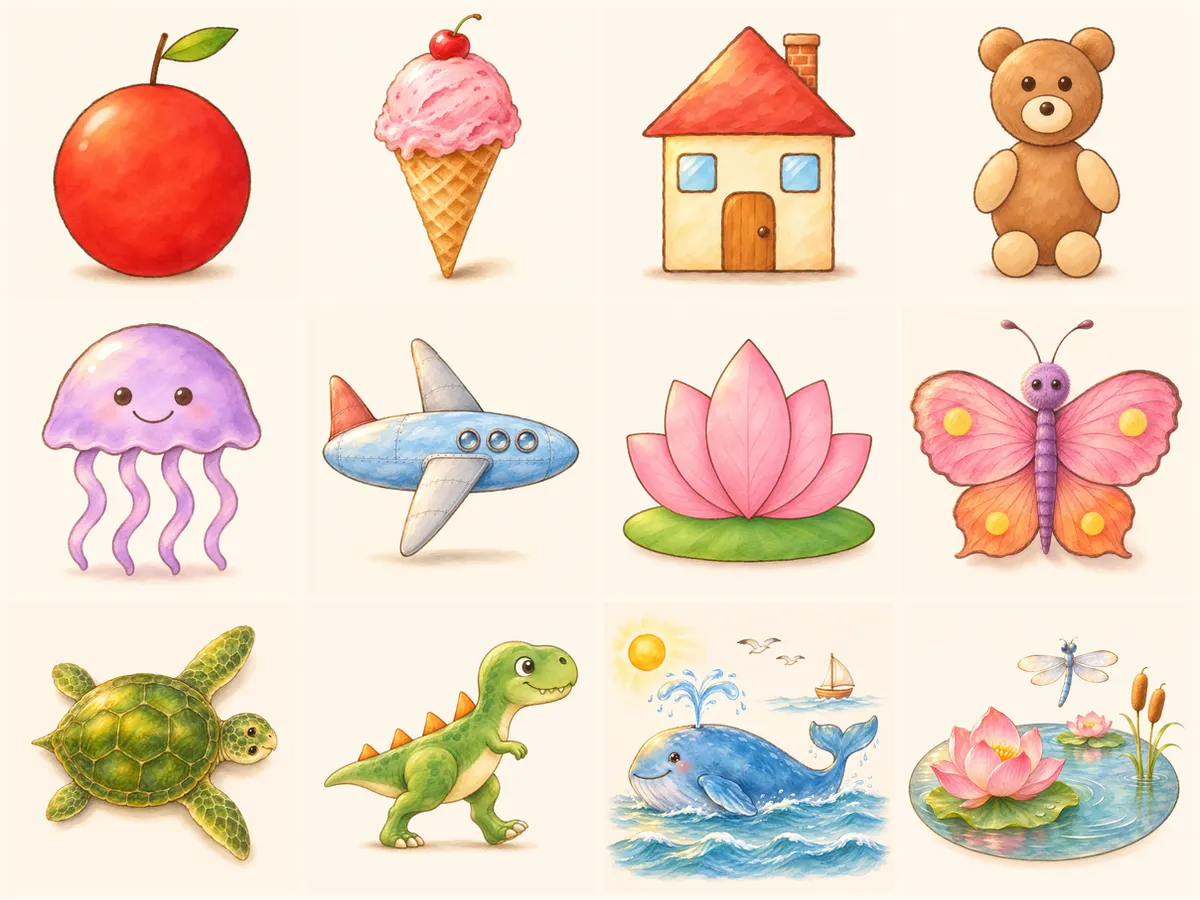
- 52 lessons across 6 levels, from Happy circle up to Lotus pond.
- 349 drawing steps in all, between 2 and 18 per lesson.
- 21 concepts, such as "Big shapes first" or "Far is small, near is big". Each lesson teaches one, and later lessons bring it back.
- 8 kinds of Let's try! game, one game in every lesson.
One lesson, beat by beat: Mushroom (Level 2)
Every lesson runs in the same order, and the order is the point: your child tries something first, hears the idea second, then draws with it. Here's the Mushroom lesson, whose concept is Big shapes first.
- The sample picture. A finished mushroom fills the whole sheet for about two seconds, so your child knows what they're about to make.
- Let's try! The app says, "Put the biggest shape first, then the small ones!" The mushroom's shapes lie loose on the page, and your child drags them into place: cap first, then stalk, then the spots. Their own hands find out that the big shape holds the picture together.
- Did you know? Straight after the game, while the mushroom they just built is still on the screen, the app reads aloud: "Artists draw the biggest shape first, then add the small parts." Practice first, the idea in words second, and in the next minute practice again.
- Drawing, one shape at a time. The app draws each shape first, then your child follows it with a finger, and every step names its shape aloud: "Draw a half circle", with the tip "Start with the biggest shape."; "Draw a rectangle" for the stalk; "Draw 2 circles"; "Make 2 dots".
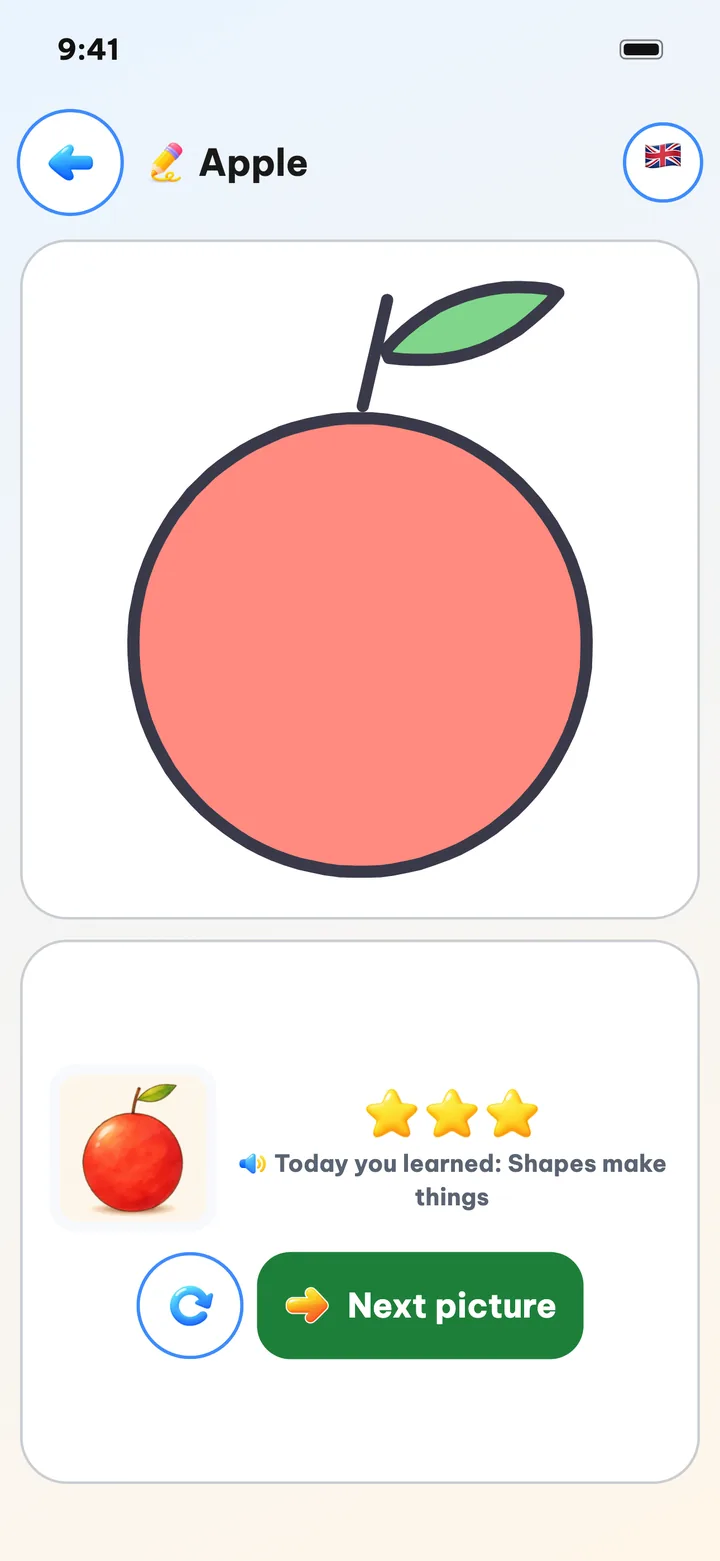
- The end screen. Stars, the line "Today you learned: Big shapes first", and the sample picture standing beside your child's own mushroom. Buttons offer Next picture, Draw again or Pick another.
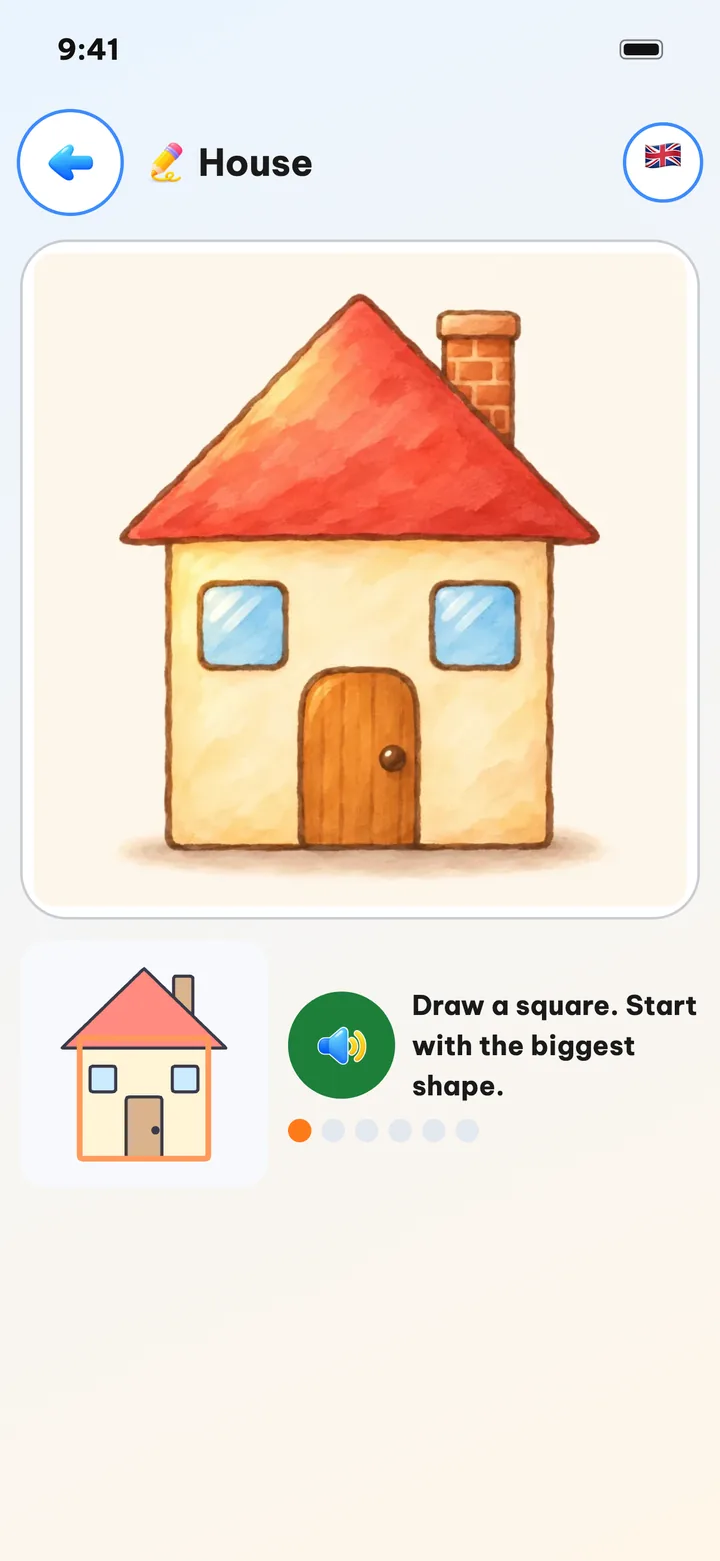
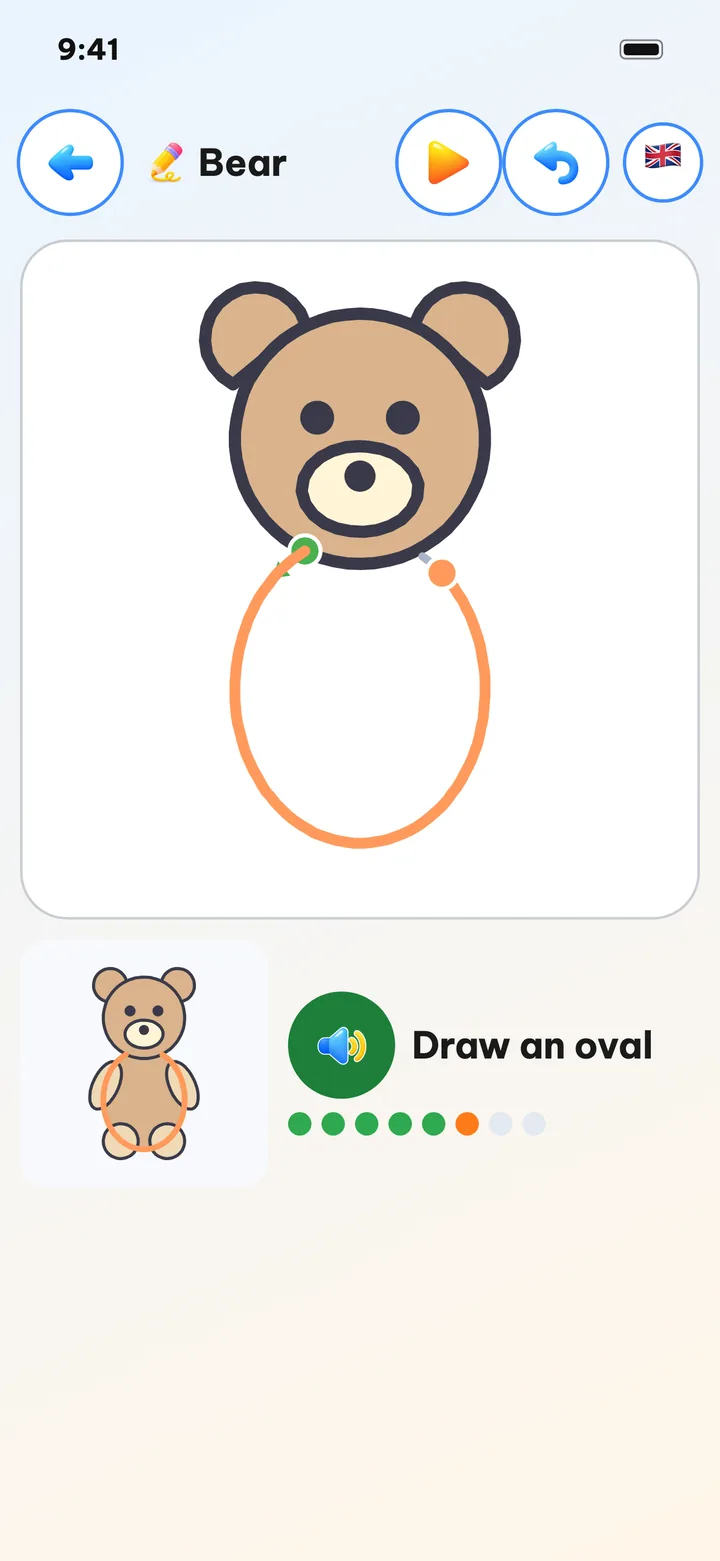
The other lessons use the same five beats. On the Bunny, the game says "Tap the shape at the back. Where is it hiding?", and the lesson that follows is "A shape in front hides part of the shape behind. Draw only what you see." On the Butterfly, your child tilts the picture first, then hears "Straight shapes look still. Tilted shapes look like they move or fly."
Three kinds of help for the same lesson
Each lesson can be drawn three ways, picked with three buttons at the top of the lesson list:
- Trace: a dashed line to follow, a green dot where the finger starts and an arrow for the direction.
- Follow dots: only a row of dots along the line.
- On my own: blank paper, with a small copy of the picture in the corner.
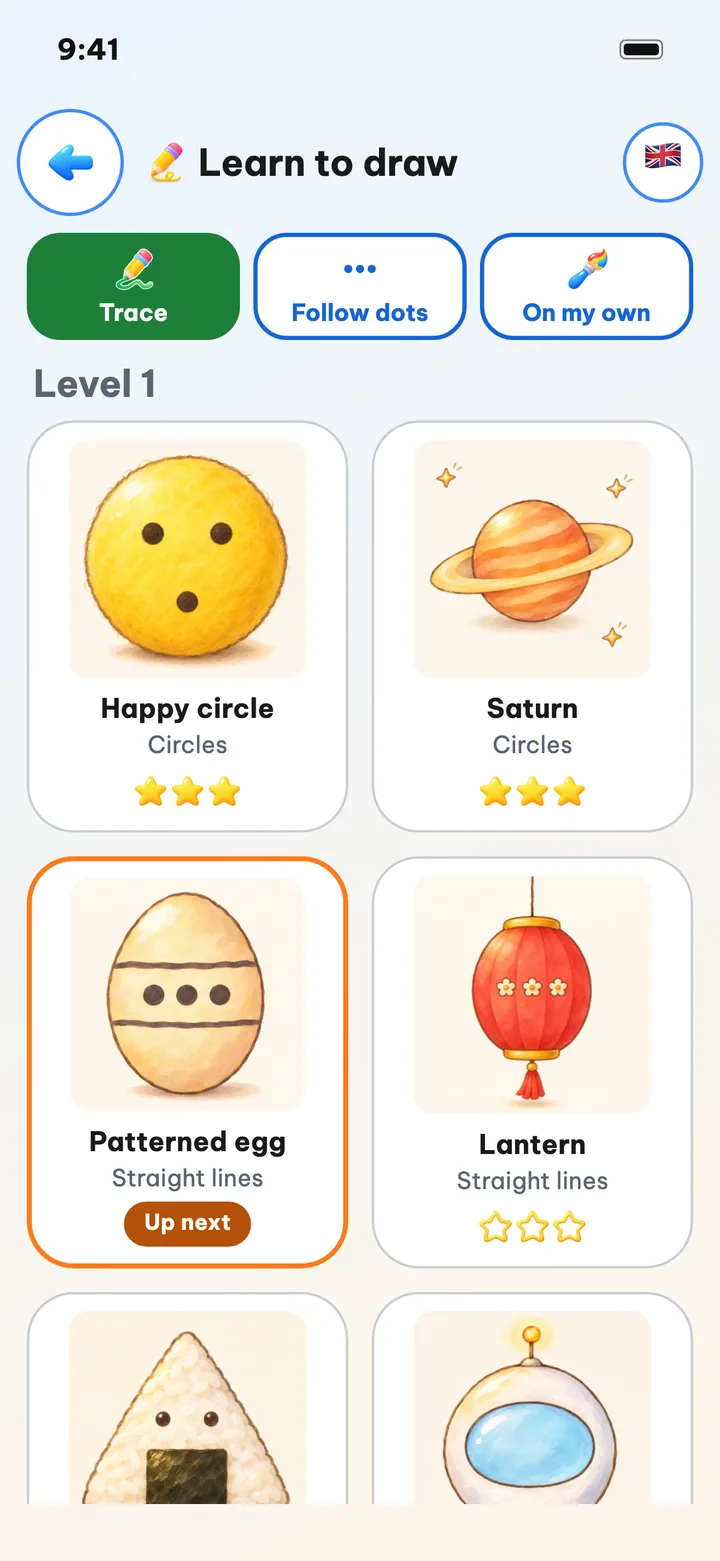
The app remembers the choice for each child's profile, so a younger and an older sibling sharing one tablet each get their own setting. A three-year-old can trace the Apple, and the same child at five can come back and draw it on their own.
The path: all six levels, every lesson
The lessons are grouped as Level 1 to Level 6. The ages below are our planning guide, not something the app shows: it displays only "Level N", locks nothing, and puts an Up next badge on the next lesson so a child always knows where to go.
- 1. Suggested age: about 3. New concepts: Circles · Straight lines · Shapes make things. Lessons, in teaching order: Happy circle, Saturn, Patterned egg, Lantern, Rice ball, Space helmet, Apple, Ice cream, Fishbowl (9).
- 2. Suggested age: about 4. New concepts: Squares and rectangles · Curved lines · Big shapes first · Shapes in front. Lessons, in teaching order: Notebook, Lucky envelope, Rainbow, Jellyfish, Happy square, Mushroom, Bunny, Gift box, Train engine, House, Bee, Penguin, Bear (13).
- 3. Suggested age: about 5. New concepts: Pointy shapes · Lines show feelings · Repeat to make patterns · Same on both sides. Lessons, in teaching order: Shooting star, Smiling star, Happy heart, Crown, Airplane, Pizza slice, Ladybug on a leaf, Pine tree, Lotus, Square robot (10).
- 4. Suggested age: about 6. New concepts: Curves show roundness · Sizes that fit · Tilted shapes move. Lessons, in teaching order: Diamond kite, Hot-air balloon, Sailboat, Truck, Pineapple, Butterfly, Castle (7).
- 5. Suggested age: about 7–8. New concepts: The outline · Surface patterns · Rhythm. Lessons, in teaching order: Rainy day, Dolphin, Long-neck dinosaur, Snail and mushroom, Sea turtle, Long train, Frog prince (7).
- 6. Suggested age: 9 and up. New concepts: Far is small, near is big · Building a character · Main and supporting parts · Near and far layers. Lessons, in teaching order: Whale and sailboat, Baby T-rex, Mountain view, Ship, Fairy kingdom, Lotus pond (6).
The shapes follow the copying milestones from earlier in this article. Level 1 leans on circles, ovals, dots and straight lines, stars and zigzags arrive at Level 3, and the diamond waits until Level 4. Steps grow too, from two in Happy circle to eighteen in Fairy kingdom. Concepts come back on purpose: Pineapple at Level 4 revisits patterns, and Castle and Diamond kite revisit symmetry.
When we put the levels together we compared them with copying milestones, England's National Curriculum, the US National Core Arts Standards and school art programmes in Vietnam and Japan. That's our own reference work, and nobody has certified the lessons.
Eight kinds of Let's try! game
Every game is something your child does with a finger, and each one sets up the idea that comes next.
- Tap to choose (9 lessons): "Tap the round things!", "Tap the things with four corners!", "Tap the things with pointy tips!" Your child spots a shape in everyday objects before drawing it.
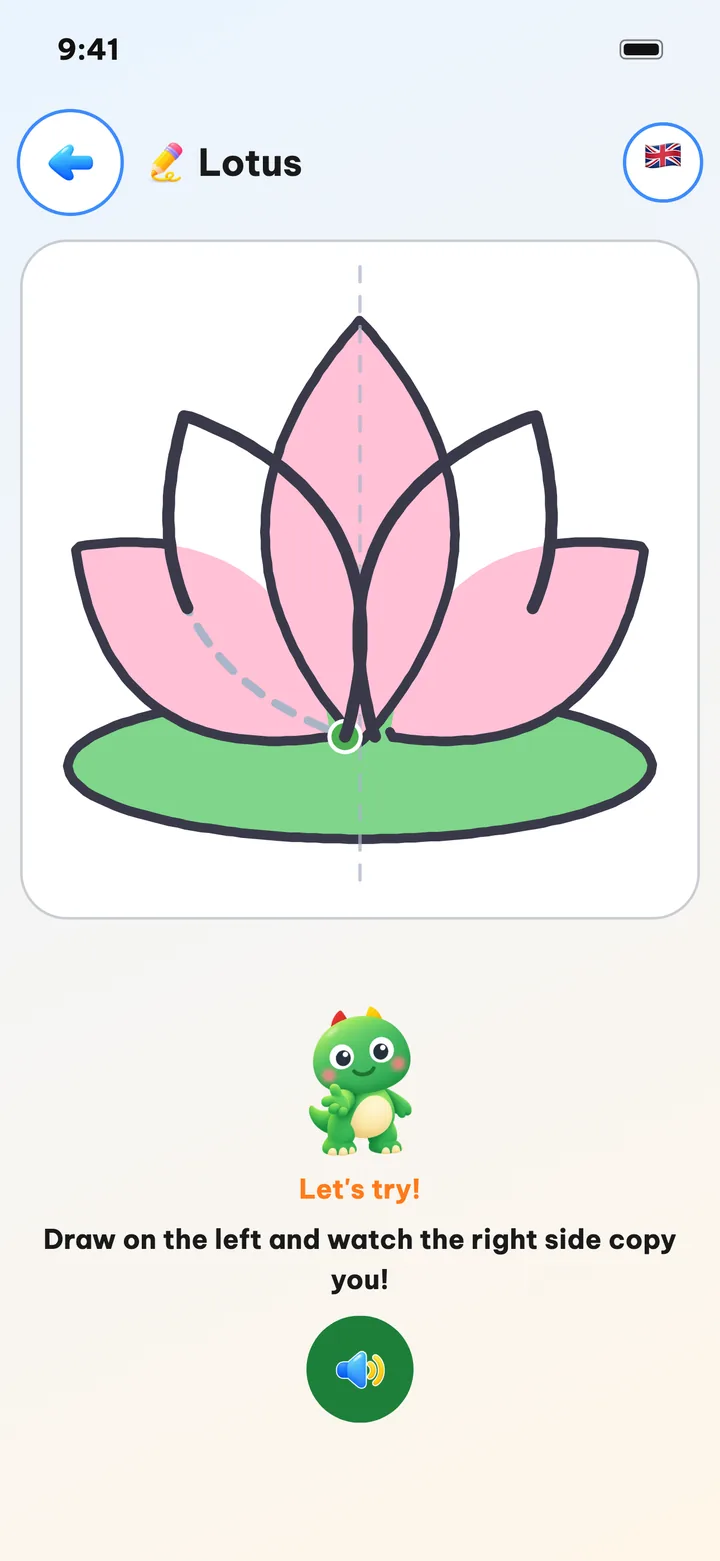
- Draw a line (10 lessons): "Slide your finger straight from dot to dot!", "Draw a soft bendy line, like a rainbow!", "Draw a mouth. Bend it up for a smile!", and on the Lotus, Square robot, Diamond kite and Castle, "Draw on the left and watch the right side copy you!", a first feel for symmetry.
- Build from shapes (9 lessons): "Drag the shapes into place to build it!", then "Put the biggest shape first, then the small ones!", and on the Baby T-rex, "Build the body with the big shapes first!"
- Front and back (6 lessons): "Tap the shape at the back. Where is it hiding?" teaches overlap. In the last two lessons it becomes "Put each thing near or far away!", which builds a scene in layers.
- Patterns (7 lessons): "Which shape comes next? Tap to keep the line going!", "Tap the empty spots to stamp the pattern!" on a snail shell or a turtle's back, and "Big, small, big, small… what comes next?" for rhythm on the Long train.
- Resize (6 lessons): "Make it just the right size for the picture!" compares the size of parts. "Drag it far away and watch it get small!" shows distance, and "Tap the main thing to make it big in the middle!" is a first lesson in composition.
- Change the shape (2 lessons): "Tilt the picture and watch it move!" on the Butterfly, and "Tap it and the curved lines make it puff up!" on the Hot-air balloon, where curved lines turn a flat shape round.
- Trace the outline (3 lessons): "Trace all the way round the shadow. What is it?" Your child runs a finger round a grey silhouette until the Dolphin or the Long-neck dinosaur appears, which leads into "outline first, details after".
Nobody fails a lesson
Learn to draw has no red, no crosses and no zero stars. The games don't count towards stars at all. If a child gets stuck in a game, a hand points to the right spot, and then the app does that step for them. If a shape won't come out after several tries, the app draws it and moves on, so a lesson always reaches its end screen.
Every step has a sentence read aloud, and there's a Listen again button. With the app drawing each shape first and a hand showing where to go, a child who can't read yet can get through a whole lesson alone.
For older brothers and sisters
When the six levels run out, the next tile in the Art subject is Advanced drawing: 32 more lessons at Levels 7 to 10, on 3D shapes, light and shade, perspective and figures. We've written about it in drawing for tweens and teens.
Alongside paper
A finger on glass can't teach how a crayon drags on paper, so keep a box of crayons within reach. After a lesson, ask your child to draw the same mushroom on paper, big shape first. When your child wants no lesson at all, Free drawing is right next door. We've written about how much screen time suits a three-year-old, and the Learn to draw page has a quick tour.
Good to know
- The lessons come with the app. The sample pictures and the read-aloud voice are downloaded from our server, so the first time needs a connection.
- Dino Kids is free: no ads, no in-app purchases, no account needed. It's something Digi Dinos makes for the community, not a revenue channel.
- If you don't see Learn to draw, update the app to the latest version.
- If a lesson seems too hard for its level, or you have an idea for a new picture, write to us at dinokids@digidinos.com.
References
- Beery, K. E., Buktenica, N. A., and Beery, N. A. Beery-Buktenica Developmental Test of Visual-Motor Integration (Beery VMI). Pearson. Age norms for copying shapes.
- Bonawitz, E., Shafto, P., Gweon, H., Goodman, N. D., Spelke, E., and Schulz, L. (2011). The double-edged sword of pedagogy: Instruction limits spontaneous exploration and discovery. Cognition, 120(3), 322–330.
- Carlson, A. G., Rowe, E., and Curby, T. W. (2013). Disentangling fine motor skills' relations to academic achievement. The Journal of Genetic Psychology, 174(5), 514–533.
- Cox, M., Cooke, G., and Griffin, D. (1995). Teaching children to draw in the infants school. Journal of Art & Design Education, 14(2), 153–163.
- Department for Education (2026). Early years foundation stage statutory framework for group and school-based providers. ELG: Fine Motor Skills; ELG: Creating with Materials.
- Department for Education (2013). National curriculum in England: art and design programmes of study.
- Gunderson, E. A., Gripshover, S. J., Romero, C., Dweck, C. S., Goldin-Meadow, S., and Levine, S. C. (2013). Parent praise to 1- to 3-year-olds predicts children's motivational frameworks 5 years later. Child Development, 84(5), 1526–1541.
- Jolley, R., and Rose, S. (2023). Drawing pictures is great for children's development – here's how parents can help. The Conversation.
- Lepper, M. R., Greene, D., and Nisbett, R. E. (1973). Undermining children's intrinsic interest with extrinsic reward. Journal of Personality and Social Psychology, 28(1), 129–137.
- Mueller, C. M., and Dweck, C. S. (1998). Praise for intelligence can undermine children's motivation and performance. Journal of Personality and Social Psychology, 75(1), 33–52.
- State Education Agency Directors of Arts Education (2014). National Core Arts Standards: Visual Arts at a Glance. VA:Cr1.1.PK, VA:Cr2.1.PK, VA:Cr2.1.K.
- Toomela, A. (2003). Developmental stages in children's drawings of a cube and a doll. TRAMES, 7(3), 164–182.